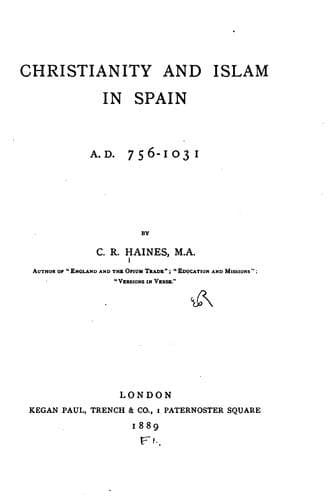
Christianity and Islam in Spain, A.D. 756-1031 — John Shaqi
Christianity and Islam in Spain, A.D. 756-1031Haines, Charles Reginald
Islamic
Christianity and Islam in Spain, A.D. 756-1031
Haines, Charles Reginald
Christian martyrs -- Spain; Christianity -- Spain; Islam -- Spain
As time went on, and the Christians and Moslems mingled more closely
together in political and social life, the Church no doubt suffered some
deterioration. Every interested motive was enlisted in favour of
dropping as far as possible out of sight[1] those distinctive features
of Christianity which might be calculated to give offence to the
Moslems; of conforming to all those Mohammedan customs, which are not in
the Bible expressly forbidden to a Christian;[2] and, generally, of
emphasizing the points on which Christianity agrees with Mohammedanism,
and ignoring those (far more important ones) in which they differ. The
Moslems had no such reason for dissembling their convictions, or
modifying their tenets. Consequently a spiritual paralysis was creeping
upon the Church, which threatened in the course of time, if not checked,
to destroy the very life of Christianity throughout the peninsula. The
case of Africa, from which Islam had extirpated Christianity, showed
that this was no imaginary danger. But Spain had this advantage over
Africa: it contained a free Christian community which had never passed
under the Moslem yoke, where the fire of Christianity, in danger of
being swept away by the devouring flames of Mohammedanism, might be
nursed and cherished, till it could again blaze forth with its former
brilliancy.
[1] See below, p. 72, note 5.
[2] _E.g.,_ circumcision.
Yet in Mohammedan Spain religious fervour was not wholly vanished: it
was still to be found among the clergy, and specially among the dwellers
in convents. Monks and nuns, severed from all worldly influences, in the
silence of their cloisters, would read the lives of the Saints[1] of
old, and meditate upon their glorious deeds, and the miracles which
their faith had wrought. They would brood over such texts as, "Ye shall
be brought before rulers and kings for My sake;"[2] and, "Every one who
shall confess Me before men, him will I also confess before My Father,
which is in Heaven;"[3] till they brought themselves to believe that it
was their imperative duty to bring themselves before rulers and kings,
and not only to confess Christ, but to revile Mohammed.
[1] See Dozy, ii. 112.
[2] St Mark xiii. 9.
[3] St Matt. x. 32.
However, the reproach of fanatical self-destruction will not apply, as
the apologists of their doings have not failed to point out, to the
first two victims that suffered in this persecution.
Public-domain text, read in full here on John Shaqi.
Reviews
Reviews
No reviews yet
Be the first to share your thoughts on this work.
Join the Discussion
Join the discussion
Sign in to leave a comment or review.
Sign InorCreate an account