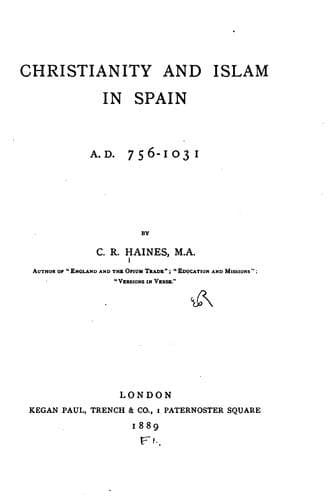
Christianity and Islam in Spain, A.D. 756-1031 — John Shaqi
Christianity and Islam in Spain, A.D. 756-1031Haines, Charles Reginald
Islamic
Christianity and Islam in Spain, A.D. 756-1031
Haines, Charles Reginald
Christian martyrs -- Spain; Christianity -- Spain; Islam -- Spain
Perfectus,[1] a priest of Cordova, who had been brought up in the school
attached to the church of St Acislus, on going out one day to purchase
some necessaries for domestic use, was stopped by some of the Moslems in
the street, and asked to give his opinion of their Prophet. What led
them to make this strange request, we are not told,[2] but stated thus
barely it certainly gives us the impression that it was intended to
bring the priest into trouble. For it was a well-known law in Moslem
countries that if any one cursed a Mohammedan, he was to be scourged,[3]
if he struck him, killed: the latter penalty also awaiting any one who
spoke evil of Mohammed, and extending even to a Mussulman ruler, if he
heard the blasphemy without taking notice of it.[4] Perfectus,
therefore, being aware of this law, gave a cautious[5] answer, declining
to comply with their request until they swore that he should receive no
hurt in consequence of what he might say. On their giving the required
stipulation, he quoted the words, "For there shall arise false Christs
and false prophets, and shall show great signs and wonders; insomuch
that if it were possible they shall deceive the very elect,"[6] and
proceeded to speak of Mohammed in the usual fashion, as a lying impostor
and a dissolute adulterer, concluding with the words, "Thus hath he, the
encourager of all lewdness, and the wallower in his own filthy lusts,
delivered you all over to the indulgence of an everlasting sensuality."
This ill-advised abuse of one, whom the Moslems revere as we revere
Christ, and the ungenerous advantage taken of the oath, which they had
made, naturally incensed his hearers to an almost uncontrollable degree.
They respected their promise, however, and refrained from laying hands
on him at that time, with the intention, says Eulogius, of revenging
themselves on a future occasion.[7]
[1] Eulogius, "Mem. Sanct.," ii., ch. i. secs. 1-4: Alvar,
"Indic. Lum.," sec. 3.
[2] See, however, Appendix A, p. 158.
[3] Alvar, "Ind. Lum.," sec. 6. "Ecce enim lex publica pendet,
et legalis iussa per omnem regnum eorum discurrit, ut, qui
blasphematur, flagellatur, et qui percusserit occidatur."
Neander V., p. 464, note, points out that "blasphemaverit"
refers to cursing Moslems, not Mohammed. Eul., "Mem. Sanct.,"
Pref., sec. 5, "Irrefragibilis manet sententia, animadverti
debere in eos qui talia de ipso non vcrentur profiteri." On
hearing of Isaac's death the king published a reminder on this
law.
[4] See p. 91.
[5] Alvar, "Ind. Lum.," sec. 3, calls it a timid answer.
[6] Matt. xxiv. 24.
[7] "Accensum ultionis furorem in corde ad perniciem eius
reponunt." Eulogius, 1.1.
Public-domain text, read in full here on John Shaqi.
Reviews
Reviews
No reviews yet
Be the first to share your thoughts on this work.
Join the Discussion
Join the discussion
Sign in to leave a comment or review.
Sign InorCreate an account