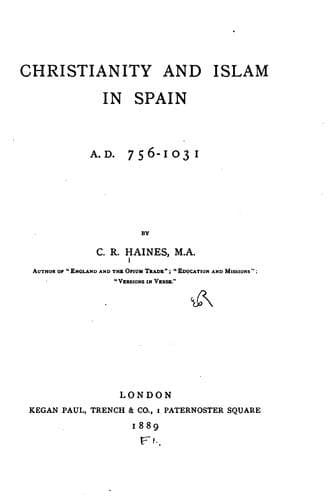
Christianity and Islam in Spain, A.D. 756-1031Haines, Charles Reginald
Islamic
Christianity and Islam in Spain, A.D. 756-1031
Haines, Charles Reginald
Christian martyrs -- Spain; Christianity -- Spain; Islam -- Spain
Scarcely had this been well done, when we perceive the first indications
of the advent of a far more terrible foe, the rumours of whose
irresistible prowess had marched before them. The dread, which the Arabs
aroused even in distant Spain as early as a century after the birth of
Mohammed, may be appreciated from the despairing lines of Julian,[1]
bishop of Toledo:--
"Hei mihi! quam timeo, ne nos malus implicet error,
Demur et infandis gentibus opprobrio!
Africa plena viris bellacibus arma minatur,
Inque dies victrix gens Agarena furit."
Before giving an account of the Saracen invasion and its results, it
will be well to take a brief retrospect of the condition of Christianity
in Spain under the Gothic domination, and previous to the advent of the
Moslems.
[1] Migne's "Patrologie," vol. xcvi. p. 814.
There can be no doubt that Christianity was brought very early into
Spain by the preaching, as is supposed, of St Paul himself, who is said
to have made a missionary journey through Andalusia, Valencia, and
Aragon. On the other hand, there are no grounds whatever for supposing
that James, the brother of John, ever set foot in Spain. The "invention"
of his remains at Ira Flavia in the 9th century, together with the story
framed to account for their presence in a remote corner of Spain so far
from the scene of the Apostle's martyrdom, is a fable too childish to
need refutation.
The honour of first hearing the Gospel message has been claimed (but, it
seems, against probability) for Illiberis.[1] However that may be, the
early establishment of Christianity in Spain is attested by Irenæus, who
appeals to the Spanish Church as retaining the primitive doctrine.[2]
The long roll of Spanish martyrs begins in the persecution of Domitian
(95 A.D.) with the name of Eugenius, bishop of Toledo. In most of the
succeeding persecutions Spain furnished her full quota of martyrs, but
she suffered most under Diocletian (303). It was in this emperor's reign
that nearly all the inhabitants of Cæsar Augusta were treacherously
slaughtered on the sole ground of their being Christians; thus earning
for their native city from the Christian poet Prudentius,[3] the proud
title of "patria sanctorum martyrum."
[1] Florez, "España Sagrada," vol. iii. pp. 361 ff.
[2] Bk. I. ch. x. 2 (A.D. 186).
[3] 348-402 A.D.
The persecution of Diocletian, though the fiercest, was at the same time
the last, which afflicted the Church under the Roman Empire. Diocletian
indeed proclaimed that he had blotted out the very name of Christian and
abolished their hateful superstition. This even to the Romans must have
seemed an empty boast, and the result of Diocletian's efforts only
proved the truth of the old maxim--"the blood of martyrs is the seed of
the Church."
Public-domain text, read in full here on John Shaqi.
Reviews
Reviews
No reviews yet
Be the first to share your thoughts on this work.
Join the Discussion
Join the discussion
Sign in to leave a comment or review.
Sign InorCreate an account