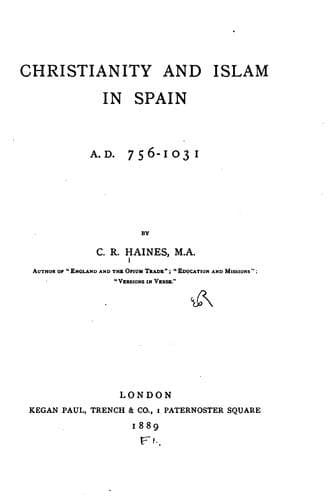
Christianity and Islam in Spain, A.D. 756-1031Haines, Charles Reginald
Islamic
Christianity and Islam in Spain, A.D. 756-1031
Haines, Charles Reginald
Christian martyrs -- Spain; Christianity -- Spain; Islam -- Spain
The Spanish Christians about this time[1] held the first ecclesiastical
council whose acts have come down to us. This Council of Illiberis, or
Elvira, was composed of nineteen bishops and thirty-six presbyters, who
passed eighty canons.
[1] The date is doubtful. Blunt, "Early Christianity," p. 209,
places it between 314 and 325, though in a hesitating manner.
Other dates given are 300 and 305.
The imperial edict of toleration was issued in 313, and in 325 was held
the first General Council of the Church under the presidency of the
emperor, Constantine, himself an avowed Christian. Within a quarter of a
century of the time when Diocletian had boasted that he had extirpated
the Christian name, it has been computed that nearly one half of the
inhabitants of his empire were Christians.
The toleration, so long clamoured for, so lately conceded, was in 341
put an end to by the Christians themselves, and Pagan sacrifices were
prohibited. So inconsistent is the conduct of a church militant and a
church triumphant! In 388, after a brief eclipse under Julian,
Christianity was formally declared by the Senate to be the established
religion of the Roman Empire.
But the security, or rather predominance, thus suddenly acquired by the
church, resting as it did in part upon royal favour and court intrigue,
did not tend to the spiritual advancement of Christianity. Almost
coincident with the Edict of Milan was the appearance of Arianism,
which, after dividing the Church against itself for upwards of
half-a-century, and almost succeeding at one time in imposing itself on
the whole Church,[1] finally under the missionary zeal of Ulphilas found
a new life among the barbarian nations that were pressing in upon all
the northern boundaries of the Empire, ready, like eagles, to swoop down
and feast upon her mighty carcase.
[1] At the Council of Rimini in 360. "Ingemuit totus orbis,"
says Jerome, "et Arianum se esse miratus est."
Most of these barbaric hordes, like the Goths and the Vandals, adopted
the semi-Arian Christianity first preached to them by Ulphilas towards
the close of the fourth century. Consequently the nations that forced
their way into Southern Gaul, and over the Pyrenees into Spain, were,
nominally at least, Christians of the Arian persuasion. The extreme
importance to Spain of the fact of their being Christians at all will be
readily apprehended by contrasting the fate of the Spanish provincials
with that which befell the Christian and Romanized Britons at the hands
of our own Saxon forefathers only half-a-century later.
Meanwhile the Church in Spain, like the Church elsewhere, freed from the
quickening and purifying influences of persecution, had lost much of its
ancient fervour. Gladiatorial shows and lascivious dances on the stage
began to be tolerated even by Christians, though they were denounced by
the more devout as incompatible with the profession of the Christian
faith.
Public-domain text, read in full here on John Shaqi.
Reviews
Reviews
No reviews yet
Be the first to share your thoughts on this work.
Join the Discussion
Join the discussion
Sign in to leave a comment or review.
Sign InorCreate an account