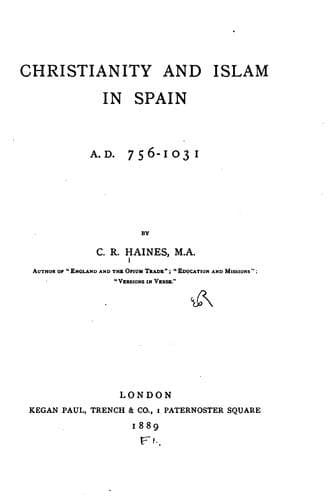
Christianity and Islam in Spain, A.D. 756-1031Haines, Charles Reginald
Islamic
Christianity and Islam in Spain, A.D. 756-1031
Haines, Charles Reginald
Christian martyrs -- Spain; Christianity -- Spain; Islam -- Spain
In 950 Abdurrahman had sent an embassy to the emperor. A bishop who had
been at the head of this embassy died, and this seems to have caused a
delay in the answer. As the Khalif's letter contained blasphemies
against Christ, it was determined to write a reply in the king's name,
such as might perhaps convince Abdurrahman of the error of his ways. A
certain bishop, Adalbero, was appointed to be at the head of the return
embassy,[2] and he asks the abbot of the monastery of Gorz to give him
two assistants. Two are chosen, but one of these quarrels with his
superior, and is expelled from the body; whereupon John offers himself
as a substitute. The abbot only gives his consent to John's going with
great reluctance, knowing that the young monk had an ardent longing to
be a martyr, if he could only get the opportunity.
[1] See "Vita Johannis Abbatis Gorziensis," 973, by John, Abbot
of Arnulph. "Migne," vol. cxxxvii., pp. 239-310.
[2] In 953.
Going through Lyons, and by ship to Barcelona, the ambassadors reached
the frontier town, Tortosa, and at last got to Cordova, where they were
assigned a house two miles from the palace, and, though well
entertained, were informed, to their dismay, that, as the Moorish
ambassadors had been made to wait three years for an answer, Otho's
messengers would have to wait nine years. Moreover, they now discovered
that the king had been already apprised of the contents of the letter,
which Otho had sent, by a comrade of the late ambassador-bishop, whom
John and his companions had taken with them to Barcelona.
Public-domain text, read in full here on John Shaqi.
Reviews
Reviews
No reviews yet
Be the first to share your thoughts on this work.
Elsewhere in the archive
Join the Discussion
Join the discussion
Sign in to leave a comment or review.
Sign InorCreate an account