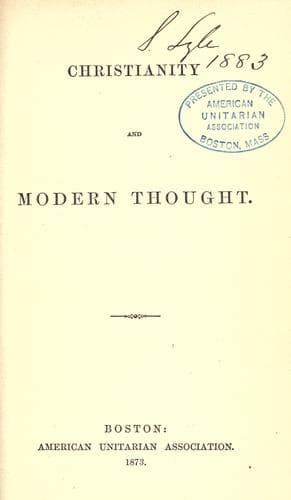
Christianity and Modern ThoughtPeabody, Andrew P. (Andrew Preston)
Religion
Christianity and Modern Thought
Peabody, Andrew P. (Andrew Preston)
Unitarianism
Self-culture will never supersede worship, more than golden lamps
burning fragrant oils will ever supersede the sun; more than digging and
hoeing and planting will supersede sunshine and rain from heaven.
Self-culture? Yes: by all means, and in any amount, but not as an end.
When people look to ornamental gardening for the crops that are to feed
the famine-smitten world, and not to the pastures and prairies, as they
lie in the light of the common sun, they will look to self-culture for
the characters, the hearts, the souls that glorify God and lift and
bless the world. "Thou shalt love the Lord thy God with all thy heart,
and thy neighbor as thyself." That is the irrepealable law of growth.
"Seek first the kingdom of God and his righteousness, and all other
things shall be added unto you." Worship, faith, duty, devotion to God,
Christ, humanity, to justice, freedom, truth,--these, and not
self-culture, have lifted the race and the world. Learn, acquire,
cultivate, improve, develop yourselves, by art, music, reading,
languages, study, science, experience, but do it all in seeking to know
and love and serve God and man. Seek to know Christ, and you will learn
more, indirectly, than though you sought all knowledge without this
thirst. Seek to know God, and you shall find all science and culture
healthful, sacred, harmonious, satisfying, and devout.
The break between modern thought and ancient creeds and worship, thus
considered, though serious, and worth the utmost pains to heal, by all
arts that do not conceal or salve over, without curing the wound, is not
permanently discouraging to earnest and well-considered Christian
faith. Nor are all the signs of the times one way. For--after all that
has been said about the restless and dissatisfied condition of the
critical and conscious thought of the time, and the scepticism of the
learned, or the speculative class, or of the new thinkers born of the
physical progress of the age, and the decay of worship in the literary
and artistic, the editorial and poetical circles--it remains to be said,
that, leaving this important and valuable body of people aside,--not
badly employed, and not without personal warrant for their doubts and
withdrawal from positive institutions,--there remains a mighty majority,
on whom the Christian religion and historical faith and the external
church have a vigorous and unyielding hold; whose practical instincts
and grand common-sense and hereditary experience anchor them safely in
positive faith, while the scepticism raves without and blows itself
clear, and passes over. Christianity first addressed itself to common
people, not to avoid criticism, but to secure the attention of the moral
affections and the spiritual powers, instead of the meaner
understanding. It has lived on the heart and conscience and needs and
yearnings of the masses, from and to whom practical wisdom and fixed
institutions and simple faith always come and always return. Common
Public-domain text, read in full here on John Shaqi.
Reviews
Reviews
No reviews yet
Be the first to share your thoughts on this work.
Join the Discussion
Join the discussion
Sign in to leave a comment or review.
Sign InorCreate an account