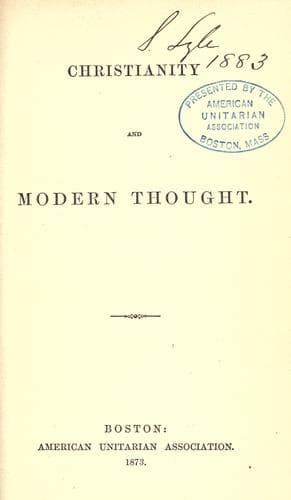
Christianity and Modern ThoughtPeabody, Andrew P. (Andrew Preston)
Religion
Christianity and Modern Thought
Peabody, Andrew P. (Andrew Preston)
Unitarianism
sense is not the sense that is common, but the sense that is _in_
common. And popular faith is not the faith of private ignorance massed,
but of that wisdom which alone enables ignorant people to find a basis
for feelings and actions that all feel to be beyond and above their
private ignorance or self-will. The common people were the first to hear
Christ gladly: they will be the last to hear any who deny him.
It is easy to exaggerate the decline of modern faith, and to misread the
tendencies of the time on which we have been dwelling. Thus, paradox
though it seem, it were just as true to say that more people are
deliberately interested in Christian faith and worship to-day than at
any previous era in the history of our religion, as to asseverate that
more people doubt and regret it than ever before. Both statements are
true; and they are reconciled only by the fact that it is only in this
century that the claims of faith and worship have been popularly
debated, or that the people were expected or allowed to have any
independent opinion about them. The general soil of our humanity is for
the first time surveyed and sown; and it is found that, with more
_wheat_ than ever, there are also more _tares_. With more intelligent
and convinced worshippers, there are more wilful or logical neglecters
of worship; with more genuine believers, more sceptics; with more
religious activity, more worldliness. Without an army in the field,
there will be no deserters; without a common currency of genuine coin,
no counterfeits; without a formidable body of affirmers, few deniers.
Public-domain text, read in full here on John Shaqi.
Reviews
Reviews
No reviews yet
Be the first to share your thoughts on this work.
Join the Discussion
Join the discussion
Sign in to leave a comment or review.
Sign InorCreate an account