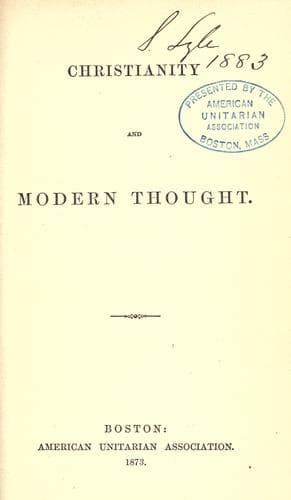
Christianity and Modern ThoughtPeabody, Andrew P. (Andrew Preston)
Religion
Christianity and Modern Thought
Peabody, Andrew P. (Andrew Preston)
Unitarianism
I. Under the name of the "Experience Philosophy," this theory has long
been applied to the _mind of the individual_; and has produced not a few
admirable analyses of the formation of language and the tissue of
thought; nor is there any legitimate objection to it, except so far as
its simplifications are overstrained and cannot be made good. It
undertakes, with a minimum of initial capacity, to account for the
maximum of human genius and character: give it only the sensible
pleasures and pains, the spontaneous muscular activity, and the law by
which associated mental phenomena cling together; and out of these
elements it will weave before your eyes the whole texture of the perfect
inner life, be it the patterned story of imagination, the delicate web
of the affections, or the seamless robe of moral purity. The outfit is
that of the animal; the product but "a little lower than the angel." All
the higher endowments--our apprehension of truth, our consciousness of
duty, our self-sacrificing pity, our religious reverence--are in this
view merely transformed sensations; the disinterested impulses are
refinements spun out of the coarse fibre of self-love; the subtlest
intellectual ideas are but elaborated perceptions of sight or touch;
and the sense of Right, only interest or fear under a disguise. If this
be so, how will the discovery affect our natural trust in the
intimations of our supreme faculties? Does it not discharge as dreams
their most assured revelations? By intuition of Reason we believe in the
Law of Causality, in the infinitude of Space, in the relations of
Number, in the reality of an outside world, in all the fundamental
conceptions of Science; but here are they, one and all, recalled to the
standard of Sense, which they seem to transcend, and emptied of any
meaning beyond. By vision of Imagination we see an ideal beauty
enfolding many a person and many a scene, and appealing to us as a
pathetic light gleaming from within; but here we find it all resolved
into curvature of lines and adjustments of color. By inspiration of
Conscience we learn that our sin is the defiance of a Divine authority,
and, though hid from every human eye, drives us into a wilderness of
Exile,--for "the wicked fleeth, though no man pursueth;" but here we are
told that the ultimate elements of good and evil are our own pleasures
and pains, from which the moral sanction selects as its specialty the
approbation and disapprobation of our fellow-men. Thus all the
independent values which our higher faculties had claimed for their
natural affections and beliefs are dissipated as fallacious; they are
all based upon a _sentient measure_ of worth which lies at the bottom;
they are like paper money, refined contrivances representative of the
ultimate gold of pleasure, but, where not interchangeable with this,
intrinsically worthless. And so the feeling almost inevitably spreads,
that we are dupes of our own characteristic capacities; that the loftier
Public-domain text, read in full here on John Shaqi.
Reviews
Reviews
No reviews yet
Be the first to share your thoughts on this work.
Elsewhere in the archive
Join the Discussion
Join the discussion
Sign in to leave a comment or review.
Sign InorCreate an account