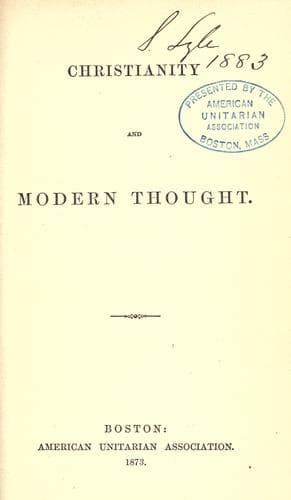
Christianity and Modern ThoughtPeabody, Andrew P. (Andrew Preston)
Religion
Christianity and Modern Thought
Peabody, Andrew P. (Andrew Preston)
Unitarianism
air into which they lift us is a tinted and distorting medium, and
shows us glories that are not there; that the idea of an eternal Fount
of beauty, truth and goodness, behind the pleasingness and concinnity of
phenomena, is an illusion; and that the tendency, irresistible as it is,
to cling to this idea as something higher than its denial, is but a part
of the romance. Is this scepticism imaginary? Let any one, in studying
the modern writers of this school, compare the solid, manly, sensible
way in which they deal with every thing on the physiological and
sensational level, with their manner towards all the convictions and
sentiments usually recognized as the supreme lights of our nature; the
tone now of forbearing indulgence, now of sickly appreciation, often of
hardly concealed contempt, that is heard beneath the interminable
conjectural analyses of Moral and Religious affections,--and he will
feel the difference between the honor that is paid to truth, and the
constrained patience towards what other men revere.
By a recent extension, the theory of Evolution has been applied to the
whole natural history of our race; and the resources of _Habit_, already
serviceable in explaining the aptitudes of individuals, have been turned
to account on the larger scale of successive generations, transmitting
by inheritance the acquisitions hitherto made good. In the training of a
nature, the world thus becomes a permanent school, the interruption of
death is virtually abolished, and life is laid open to continuous
progress. By this immense gain of power, it is supposed, all the
differences which separate Man from other animals may be accounted for
as gradual attainments; and many an intuition of the mind, too immediate
and self-evident to be a product of personal experience, may yield to
analysis as a more protracted growth, and stand as the compend of ages
of gathering feeling and condensing thought. Among creatures that herd
together for common safety, each one learns to read the looks of anger
or of good-will in its neighbors, and discovers what it is that brings
upon him the one or other; and insensibly he forms to himself a rule for
avoiding the displeasure and conciliating the favor in which he has so
large an interest. This rudimentary experience imprints and records
itself in the nervous organization, and descends to ulterior generations
as an original and instinctive recoil from what offends and impulse
towards what gratifies the feeling of the tribe: so that the lesson
needs not be gone over again; but the offspring, taking up his education
where the parent left off, accumulates his feeling, quickens his mental
execution, and hands down fresh contributions to what at last emerges as
a Moral Sense. In this way, it is contended, the Conscience is a hoarded
fund of traditionary pressures of utility, gradually effacing the
primitive vestiges of fear, and dispensing itself with an affluence of
disinterested sympathy.
Public-domain text, read in full here on John Shaqi.
Reviews
Reviews
No reviews yet
Be the first to share your thoughts on this work.
Elsewhere in the archive
Join the Discussion
Join the discussion
Sign in to leave a comment or review.
Sign InorCreate an account