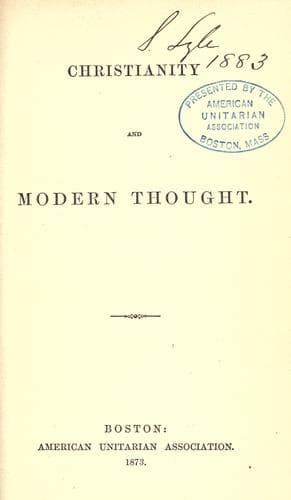
Christianity and Modern ThoughtPeabody, Andrew P. (Andrew Preston)
Religion
Christianity and Modern Thought
Peabody, Andrew P. (Andrew Preston)
Unitarianism
And the religious consciousness that visits the
soul in its remorse, of an invisible Witness and Judge who condemns the
sin, comes, we are told, from the deification of public opinion, or the
fancy that some dead hero's ghost still watches over the conduct of his
clan.
This vast enlargement of the doctrine of Evolution, while increasing its
power, and removing it from the reach of accurate tests, alters neither
its principle nor its practical effect. It undertakes to exhibit the
highest and the greatest in our nature as ulterior phenomena of the
lowest and the least. And it usually treats as a superstition our
natural reverence for the rational, moral, and religious intuitions as
sources of independent insight and ultimate authority; and, in order to
estimate them, translates them back into short-hand expressions of
sensible experience and social utility. Nor can we wonder at this
scepticism. If the only reality at bottom of the sense of duty is fear
and submission to opinion, whatever it carries in it that transcends
this ground, and persuades us of an Obligation in which fear and opinion
have no voice, is an ideal addition got up within us by causes which
produce in us all sorts of psychological figments. If the only facts
that lie in our idea of Space are a set of feelings in the muscles and
the skin and the eye, then whatever beliefs it involves which these
cannot verify are naturally discredited, and treated as curiosities of
artificial manufacture. If our human characteristics are throughout the
developed instincts of the brute, differing only in degree, then the
moment they present us with intuitions which are distinct _in kind_,
they begin to play us false; and those who see through the cheat
naturally warn us against them. And so we are constantly told that our
highest attributes are only the lower that have lost their memory, and
mistake themselves for something else.
It is not my present intention to call in question either of these
varieties of evolution. Inadequate as the evidence of them both appears
to be, I will suppose their case to be made out: and still, I submit, it
does not justify the sceptical estimate which it habitually fosters of
the intellectual, moral, and religious intuitions of the human mind.
For,
Public-domain text, read in full here on John Shaqi.
Reviews
Reviews
No reviews yet
Be the first to share your thoughts on this work.
Elsewhere in the archive
Join the Discussion
Join the discussion
Sign in to leave a comment or review.
Sign InorCreate an account