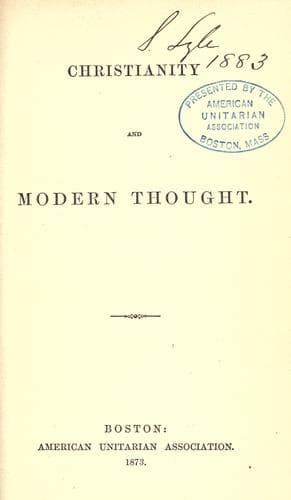
Christianity and Modern ThoughtPeabody, Andrew P. (Andrew Preston)
Religion
Christianity and Modern Thought
Peabody, Andrew P. (Andrew Preston)
Unitarianism
Conscience is the faculty by which we perceive fitness or unfitness. Its
functions are not cognitive, but judicial. Its decisions are based upon
our knowledge, real or imagined, from whatever source derived. It judges
according to such law and evidence as it has; and its verdict is always,
relatively, a genuine _verdict_ (_verum dictum_), though potentially
false and wrong by defect of our knowledge,--even as in a court of law
an infallibly wise and incorruptibly just judge may pronounce an utterly
erroneous and unjust decision, if he have before him a false statement
of facts, or if the law which he is compelled to administer be
unrighteous. What we call the education of conscience is merely the
accumulation and verification of the materials on which conscience is to
act; in fine, the discovery of fitnesses.
Permit me to illustrate the function of conscience by reference to a
question now mooted in our community,--the question as to the moral
fitness of the temperate use of fermented liquors. Among the aborigines
of Congo and Dahomey, there being no settled industry, no mental
activity, and no hygienic knowledge as to either body or mind, it seems
fitting, and therefore right, to swallow all the strong drink that they
can lay their hands upon; for it is fitted to produce immediate animal
enjoyment,--the only good of which they have cognizance. Among civilized
men, on the contrary, intoxication is universally known to be opposed to
the fitnesses of body and mind, an abuse of alcoholic liquors, and an
abuse of the drinker's own personality; and it is therefore condemned by
all consciences, by none more heartily than by those of its victims.
But there still remains open the question as to the moderate use of
fermented liquors; and this is not, as it is commonly called, a question
of conscience, but a mere question of fact,--of fitness or unfitness.
Says one party, "Alcohol, in every form, and in the least quantity, is a
virulent poison, and therefore unfit for body and mind." Says the other
party, "Wine, moderately used, is healthful, salutary, restorative, and
therefore fitted to body and mind." Change the opinion of the latter
party, their consciences would at once take the other side; and, if they
retained in precept and practice their present position, they would
retain it self-condemned. Change the opinion of the former party, their
consciences would assume the ground which they now assail. Demonstrate
to the whole community--which physiology may one day do--the precise
truth in this matter, there would remain no differences of conscientious
judgment, whatever difference of practice might still continue.
Public-domain text, read in full here on John Shaqi.
Reviews
Reviews
No reviews yet
Be the first to share your thoughts on this work.
Elsewhere in the archive
Join the Discussion
Join the discussion
Sign in to leave a comment or review.
Sign InorCreate an account