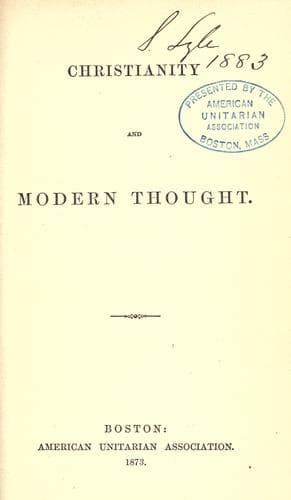
Christianity and Modern ThoughtPeabody, Andrew P. (Andrew Preston)
Religion
Christianity and Modern Thought
Peabody, Andrew P. (Andrew Preston)
Unitarianism
From what has been said, it is necessarily inferred that right and wrong
are not contingent on the knowledge of the moral agent. Unfitness,
misuse, abuse, is none the less wrong because the result of ignorance.
If the result of inevitable ignorance, it does not indeed imply an
unfitness or derangement of the agent's own moral powers. Yet it is none
the less out of harmony with the fitness of things. It deprives an
object of its due use. It perverts to pernicious results what is
salutary in its purpose. It lessens for the agent his aggregate of good
and of happiness, and increases for him his aggregate of evil and of
misery. In this sense--far more significant than that of arbitrary
infliction--the maxim of jurisprudence, _Ignorantia legis neminem
excusat_ ("Ignorance of the law excuses no one"), is a fundamental
principle of human nature.
* * * * *
We are now prepared to consider the relation of moral distinctions to
theology. In the first place, if the ground which I have maintained be
tenable, ethical science rests on a basis of its own, wholly independent
of theology. Right and wrong, as moral distinctions, in no wise depend
on the Divine will and law; nay, not even on the Divine existence. The
atheist cannot escape or disown them. They are inseparable from
existence. For whatever exists, no matter how it came into being, must
needs have its due place, affinities, adaptations, uses; and an
intelligent dweller among the things that are cannot but know something
of their fitnesses and harmonies, and, so far as he acts upon them,
cannot but feel the obligation to recognize their fitnesses, and thus to
create or restore their harmonies. Even to the atheist, vice is a
violation of fitnesses which he knows or may know. It is opposed to his
conscientious judgment. He has with regard to it an inevitable sense of
wrong. I can therefore conceive of an atheist's being--though I should
have little hope that he would be--a rigidly virtuous man, and that on
principle.
But while atheism does not obliterate moral distinctions, or cancel
moral obligation, these distinctions are a refutation of atheism; and
from the very fitness of things, which we have seen to be the ground of
right, we draw demonstrative evidence of the being, unity, and moral
perfectness of the Creator: so that the fundamental truths of theology
rest on the same basis with the fundamental principles of ethics. Let me
ask you to pursue this argument with me.
Public-domain text, read in full here on John Shaqi.
Reviews
Reviews
No reviews yet
Be the first to share your thoughts on this work.
Elsewhere in the archive
Join the Discussion
Join the discussion
Sign in to leave a comment or review.
Sign InorCreate an account