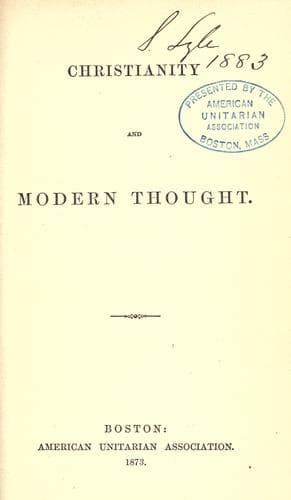
Christianity and Modern ThoughtPeabody, Andrew P. (Andrew Preston)
Religion
Christianity and Modern Thought
Peabody, Andrew P. (Andrew Preston)
Unitarianism
Every object, as I have said, must, by virtue of its existence, have its
fit place and use; but, in a world that was the dice-work of chance,
there would be myriads of probabilities to one against any specific
object's attaining to its fit place and use. This must be the work of
will alone. If chance can create, it cannot combine, co-ordinate,
organize. If it can throw letters on the ground by the handful, it
cannot arrange them into the Iliad or the Paradise Lost. If it can stain
the sky or the earth with gorgeous tints, it cannot group them into a
Madonna or a landscape. Its universe would be peopled by straylings,
full of disjointed halves of pairs,--of objects thrown together in such
chaotic heaps that seldom could any one object find its counterpart or
subserve its end.
The opposite is the case in the actual world. The first discoveries
which the first human being made were of the fitnesses of the objects
around him to himself and to one another. With every added year his
microcosm enlarged, so that, before he left the world, he had within his
cognizance a range of fitnesses and uses sufficient to guide his own
activity, and to enable him to predict its results, together with
numerous other results not contingent on his own agency. Beyond this
microcosm, indeed, lay a vast universe impenetrable to his search, in
which he could trace no relations, no filaments of order; in which all
seemed to him a medley of chaotic confusion, mutually intruding systems,
clashing and jarring forces. On this realm of the unknown man has ever
since been making perpetual aggressions; and every step of his progress
has been the discovery of fitnesses, relations, reciprocal uses, among
the most remote, diverse, and at first sight mutually hostile objects,
classes, and systems. Natural history, physics, and chemistry, are the
science of mutual fitnesses and uses among terrestrial objects.
Astronomy is the science of harmonies among all the worlds,--of
fitnesses in their relations and courses to the condition of things in
our own planet, approximately to other bodies in the solar system, and,
by ascertained analogies, to those distant orbs of which we know only
that they stand and move ever in their order. Geology is the science of
mutual fitnesses in former epochs and conditions of our own planet, and
of prospective fitnesses in them to the needs and uses of the present
epoch; so that by harmonies which run through unnumbered æons we are the
heirs, and sustain our industries by the usufruct, of the ages, the
great moments of whose history we are just beginning to read.
Mathematical science reveals geometrical and numerical fitnesses,
proportions, and harmonies, which are traced alike in the courses of the
stars and in the collocation of the foliage on the tree, and which
promise one day to give us the equation of the curve of the sea-shell,
of the contour of the geranium-leaf, of the crest of the wave. There is
Public-domain text, read in full here on John Shaqi.
Reviews
Reviews
No reviews yet
Be the first to share your thoughts on this work.
Elsewhere in the archive
Join the Discussion
Join the discussion
Sign in to leave a comment or review.
Sign InorCreate an account