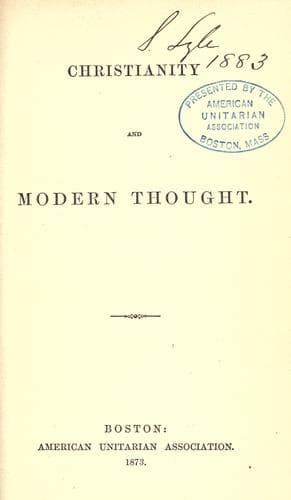
Christianity and Modern ThoughtPeabody, Andrew P. (Andrew Preston)
Religion
Christianity and Modern Thought
Peabody, Andrew P. (Andrew Preston)
Unitarianism
still around us the realm of the unknown; yet not only are daily
aggressions made upon it, but science has advanced so far as to render
it certain that there is no department or object in the universe, which
is not comprehended in this system of mutual fitnesses, harmonies, and
uses.
Now consider the relation of organized being to this system. What is an
organ? It is the capacity of perceiving, choosing, and utilizing a
fitness. The rootlets of the tree by the river-side perceive the
adjacent water, elongate themselves toward it, in a drought make
convulsive and successful efforts to reach it; while the corolla of the
heliotrope perceives the calorific rays, and turns toward their source
in the heavens. The organs of the plant select from the elements around
it such substances as are fitted to feed its growth, and appropriate
them to its use, even though they be found in infinitesimal
proportions, in masses of alien substance. In all this there is a
semi-self-consciousness, corresponding, not indeed to the action of
mind, but to that of the spontaneous life-processes in intelligent
beings.
The animal carries us a step higher. His instincts are an unerring
knowledge of fitnesses and uses within his sphere. He seeks what is
fitted, shuns what is unfitted to his sustenance and growth, is never
deceived when left to his own sagacity, and fails only when brought into
anomalous relations with the superior knowledge of man. He lives, merely
because he is conscious of the fitnesses of nature, and yields up his
life to a stronger beast, in accordance with those same
fitnesses--beneficent still--by which all realms of nature are kept
fully stocked, yet never overstocked, with healthy and rejoicing life.
The fitness which thus pervades and unifies the entire creation, man as
an animal perceives, as a living soul recognizes and comprehends; and to
his consciousness it is an imperative law, obeyed always with
self-approval, disobeyed only with self-condemnation. Of disobedience he
alone is capable, yet he but partially. In order to live, he must obey
in the vast majority of instances; still more must he obey, if he would
have society, physical comfort, transient enjoyment of however low a
type; and the most depraved wretch that walks the earth purchases his
continued being by a thousand acts of unintended yet inevitable
obedience to one of voluntary guilt. Man's law--the law which, in
violating or scorning it, he cannot ignore or evade--is the very same
fitness which runs through all inorganic nature, and which the
semi-conscious tree, shrub, or flower, the imperfectly self-conscious
bird, fish, or beast uniformly obeys.
Public-domain text, read in full here on John Shaqi.
Reviews
Reviews
No reviews yet
Be the first to share your thoughts on this work.
Elsewhere in the archive
Join the Discussion
Join the discussion
Sign in to leave a comment or review.
Sign InorCreate an account