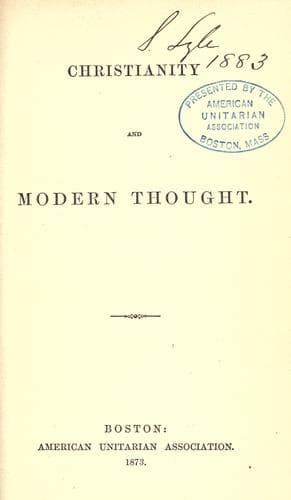
Christianity and Modern ThoughtPeabody, Andrew P. (Andrew Preston)
Religion
Christianity and Modern Thought
Peabody, Andrew P. (Andrew Preston)
Unitarianism
Now can chance have evolved this universal fitness, and the souls that
own their allegiance to it? Is it not the clear self-revelation of a
God, one, all-wise, omnipotent? Has it any other possible solution?
Bears it not, in inscriptions that girdle the universe in letters of
light, the declarations of the Hebrew seer, "In the beginning God
created the heavens and the earth," and "The Lord our God is one Lord"?
I am not disposed to cavil at the argument from design in the structure
and adaptations of any one organized being; but immeasurably more cogent
is this argument from a consenting universe, in which filaments of
fitness, relation, and use cross and recross one another from bound to
bound, from sun to star, from star to earth, from the greatest to the
least, from the order of the heavens to the zoöphyte and the microscopic
animalcule. In the human conscience I recognize at once the revelation
and the perpetual witness of this all-pervading adaptation, this
universal harmony. Conscience is the God within, not in figure, but in
fact. It is the mode in which He who is enshrined in all being, who
lives in all life, takes up his abode, holds his perpetual court, erects
his eternal judgment-seat, within the human soul.
We pass to the consideration of the moral attributes of the Creator. I
have spoken of moral distinctions as logically separable from and
independent of the Divine nature. From this position alone can we
establish the holiness, justice, and mercy of the Divine Being. In
order to show this, let me ask your attention to the distinction
between necessary and contingent truths; that is, between truths which
have an intrinsic validity, which always were and cannot by any
possibility be otherwise than true, and truths which were made true,
which began to be, and the opposite of which might have been.
Mathematical truth is necessary and absolute truth,--not made truth even
by the ordinance of the Supreme Being, but truth from the very nature of
things, truth co-eternal with God. Omnipotence cannot make two and two
five, or render the sum of the angles of a triangle more or less than
two right angles, or construct a square and a circle of both equal
perimeter and equal surface. In our conception of mathematical truth we
are conscious that it must have been true before all worlds, and would
be equally true had no substance that could be measured or calculated
ever been created. Every mathematical proposition is an inherent
property or condition of the infinite space identical with the Divine
omnipresence, or of the infinite duration identical with the Divine
eternity.
Public-domain text, read in full here on John Shaqi.
Reviews
Reviews
No reviews yet
Be the first to share your thoughts on this work.
Elsewhere in the archive
Join the Discussion
Join the discussion
Sign in to leave a comment or review.
Sign InorCreate an account