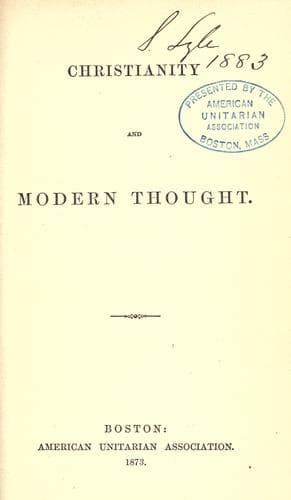
Christianity and Modern ThoughtPeabody, Andrew P. (Andrew Preston)
Religion
Christianity and Modern Thought
Peabody, Andrew P. (Andrew Preston)
Unitarianism
Moral truth is of the same order, not contingent, but necessary,
absolute. This is distinctly declared in one of the most sublime bursts
of inspiration in the Hebrew Scriptures. If you will trace in the book
of Proverbs the traits of Wisdom as personified throughout the first
nine chapters, you will find that it is no other than a name for the
inherent, immutable, eternal distinction between right and wrong. It is
this Wisdom, who, so far from confessing herself as created, ordained,
or subject, proclaims, "Jehovah possessed me in the beginning of his
way, before his works of old. I was set up from everlasting, from the
beginning, or ever the earth was.... When he prepared the heavens, I
was there.... When he appointed the foundations of the earth, then I was
by him, AS ONE BROUGHT UP WITH HIM; and I was daily his delight,
rejoicing always before him."
It is only on the principle thus vividly set forth that we can affirm
moral attributes of the Supreme Being. When we say that He is perfectly
just, pure, holy, beneficent, we recognize a standard of judgment
logically independent of his nature. We mean that the law of fitness,
which He promulgates in the human conscience, and which is our only
standard of right, is the self-elected law of his own being. Could we
conceive of omnipotence and omniscience devoid of moral attributes, the
decrees and acts of such a being would not be necessarily right.
Omnipotence cannot make the wrong right, or the right wrong; nor can it
indue either with the tendencies of the other, so that the wrong, that
is, the unfitting, should produce ultimate good, or the right, that is,
the fitting, should produce ultimate evil. God's decrees and acts are
not right because they are his; but they are his because they are right.
On no other ground, as I have said, can we affirm moral attributes of
him. If his arbitrary sovereignty can indue with the characteristics of
right that which has no intrinsic fitness, beauty, or utility, then the
affirmation that He is holy, or just, or good, is simply equivalent to
the absurd maxim of human despotism, "The king can do no wrong." It is
only when we conceive of the abstract right as existing of necessity
from a past eternity, and as a category of the Divine free-will and
perfect prescience, in which the creation had its birth and its
archetypes, that holiness, justice, and goodness, as applied to the
Divine character, have any meaning.
Public-domain text, read in full here on John Shaqi.
Reviews
Reviews
No reviews yet
Be the first to share your thoughts on this work.
Elsewhere in the archive
Join the Discussion
Join the discussion
Sign in to leave a comment or review.
Sign InorCreate an account