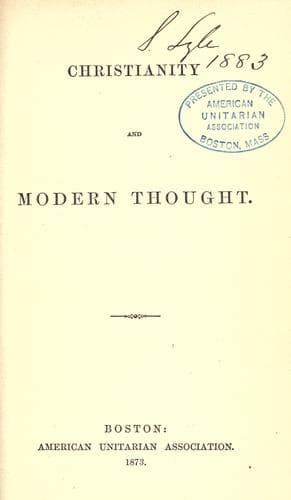
Christianity and Modern ThoughtPeabody, Andrew P. (Andrew Preston)
Religion
Christianity and Modern Thought
Peabody, Andrew P. (Andrew Preston)
Unitarianism
We thus see that our ethical conceptions underlie our theology, and
that, however explicit the words of revelation may be as to the Divine
nature, he alone can understand them, who recognizes in his own heart
the absoluteness and immutableness of moral distinctions. How many
Christians have there been in every age since the primitive, who, in
using the terms _just_ and _holy_ with reference to the Almighty, have
employed them in an entirely different sense from that in which they are
applied to human conduct, and with regard to supposed dispositions and
acts, which in man they would call unjust and cruel! And this simply
because they have attached no determinate meaning, but only a
conventional and variable sense to ethical terms, and have imagined that
arbitrary power could reverse moral distinctions, or that God could
impose on man one law of right, and himself recognize another.
We have thus seen that theology is indebted to the fundamental
principles of ethics for the most luculent demonstration of the being,
omnipotence, and omniscience of God, and for the clear conception of his
moral attributes.
* * * * *
We will now consider the reciprocal obligations of ethics to theology;
and, in the first place, to Natural Religion. Pure theism attaches the
Divine sanction to the verdicts of conscience, makes them the will, the
voice of God, enforces them by his authority, and elevates the
conception of virtue by establishing a close kindred between the
virtuous man and the Ruler of the universe. And this is much, but not
for many. It has raised some elect spirits to a degree of excellence
which might put Christians to shame. It has conjoined virtue with lofty
devotion and earnest piety in a Socrates and a Marcus Antoninus, and
refined it into a rare purity, chasteness, and tenderness of spirit in a
Plutarch and an Epictetus. But on the masses of mankind, on the worldly
and care-cumbered, on the unphilosophic and illiterate, it has exerted
little or no influence. Moreover, while among the virtuous men of
pre-Christian times and beyond the light of the Jewish revelation, we
recognize some few of surpassing excellence, we find not a single
ethical system, or body of moral precepts, which does not contain
limitations, deficiencies, or enormities utterly revolting to the moral
sense of Christendom. Thus Plato had lofty conceptions of virtue, but
there are directions in which his precepts give free license to lust and
cruelty; and even Socrates sanctioned by his unrebuking intimacy and
fondness the leaders and ornaments of the most dissolute society in
Athens.
Public-domain text, read in full here on John Shaqi.
Reviews
Reviews
No reviews yet
Be the first to share your thoughts on this work.
Elsewhere in the archive
Join the Discussion
Join the discussion
Sign in to leave a comment or review.
Sign InorCreate an account