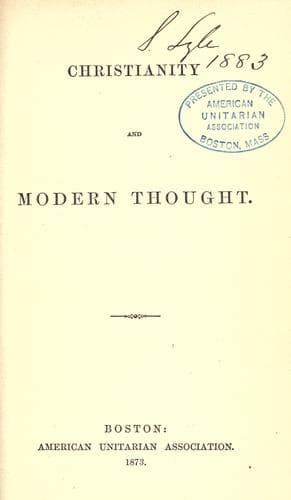
Christianity and Modern ThoughtPeabody, Andrew P. (Andrew Preston)
Religion
Christianity and Modern Thought
Peabody, Andrew P. (Andrew Preston)
Unitarianism
It is the common, simple, universal truths that are the great,
inexhaustible, powerful, and never-wearying truths. But doubtless it
requires courage, personal conviction, and self-watchfulness, to
maintain personal piety or religious institutions under free and
enlightened conditions, when they are just beginning. When sacramental
mysteries are exploded, when the official sanctity of the ministry is
disowned, when the technical and dogmatic conditions of acceptance with
God are abandoned, when every man's right of private judgment is
confessed, when common sense is invited into the inner court of faith,
when every man is confessed to be a king and a priest in that temple of
God which he finds in his own body and soul, when real, genuine goodness
is owned as the equivalent of religion, then it is evident that the
support of religious institutions, of public worship, of the church and
the ordinances, must appeal to something besides the ignorance, the
fears, the superstitions, the traditions of the Christian world. They
must fall back on the practical convictions men entertain of their
intrinsic importance. They must commend themselves to the sober, plain,
and rational judgment of men of courage, reflection, and observation.
They fall into the same category with a government based not on the
divine right of kings, or the usages of past generations, the artificial
distinctions of ranks and classes, owing fealty each to that which is
socially above itself, but resting on the consent of the governed, and
deriving its authority and its support from the sense of its usefulness
and necessity. We have not yet achieved fully, in this country, the
passage of the people over from the Old World status of _subjects_ to
the New World status of _citizens_. We are in the midst of the glorious
struggle for a State, a national government, which rests securely on the
love and service of hearts that have created it, and maintain and defend
it on purely rational and intelligible grounds. It is so new, so
advanced, so sublime an undertaking, that we often falter and faint, as
if man were not good enough, nor reasonable enough, to be entitled to
such a government. We often doubt if we can bear the dilution which the
public virtue and good sense in our native community suffers from the
flood of ignorance and political superstition coming with emigrants from
other and coarser states of society and civil organizations. We are not
half alive to the glory and grandeur of the experiment of free political
institutions, and do not press with the zeal we ought the general
education, the political training, the moral discipline, which can alone
save the State, when it has no foundation but the good-will, the
respect, and the practical valuation of the people. But is the State or
the nation ever so truly divine as when it is owned as the voice of God,
calling all the people to maintain equal justice, to recognize universal
Public-domain text, read in full here on John Shaqi.
Reviews
Reviews
No reviews yet
Be the first to share your thoughts on this work.
Join the Discussion
Join the discussion
Sign in to leave a comment or review.
Sign InorCreate an account