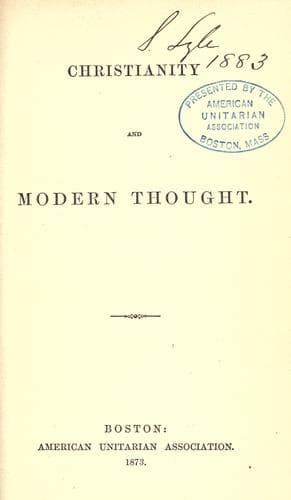
Christianity and Modern ThoughtPeabody, Andrew P. (Andrew Preston)
Religion
Christianity and Modern Thought
Peabody, Andrew P. (Andrew Preston)
Unitarianism
interests, to embody Christian ethics in public law? And despite our
local mortifications and occasional misgivings, what nation is now so
strong and firm, what government so confident and so promising, as our
own? What but freedom, fidelity to rational principles and ideal
justice, give it this strength? What is it, on the other hand, but
traditions that represent the ignorance and accidents and injustice of
former ages,--what is it but authority usurped and then consecrated,
social superstitions hardened into political creeds,--that is now
proving the weakness and peril of European nationalities, and imperial
or monarchical governments? Knowledge, science, literature, progress,
truth, liberty, become sooner or later the enemies of all governments,
and all social institutions, not founded in abstract justice and equal
rights. Yet how fearful the transition! Who can contemplate the downfall
of the French empire, and then look at the architects of the new
republic, working in the crude material of a priest-ridden or unschooled
populace, without dismay? Yet the process is inevitable. Democratic
ideas are abroad: they are in the air. They corrode all the base metal
they touch; and thrones and titles, and legalized classes, and
exceptional prerogatives, are predestined to a rapid disintegration. How
blessed the nation that has transferred its political homage from
traditions to principles; from men or families, to rights and duties;
from a compromise with ancient inequality and wrong, to an affirmation
of universal justice and right! Yet never had a people so grave and so
constant and so serious duties as we have. And there is nothing in our
principles or government that _must_ save our country, in spite of the
failure of political virtue, intelligence, and devotion, in our private
citizens. God has buried many republics, because the people were
unworthy of them. Their failure was no disproof of the principle
involved, but only an evidence that the people fell wholly below their
privileges and ideas. America may add another to this list of failures,
but can do nothing to discredit the truth and glory and final triumph of
the democratic idea. I do not believe we shall fail; on the contrary, I
have an increasing faith in the sense and virtue and ability of the
people of this country. But the success of American political
institutions depends very much on the success of the Christian and
religious institutions that match them, and are alone adapted to them.
We cannot long guarantee religious institutions, in a country of free
schools, public lyceums, unlicensed newspapers, unimpeded inquiry, and
absolute religious equality, if they do not rest on grounds of reason
and experience and sober truth. Mere authority, mere ecclesiasticism,
mere sacred usages, mere mystery, or mere dogmatism, will not long
protect the creeds and formularies of the church. They are undergoing a
species of dry-rot, like to that which the rafters of my own church
Public-domain text, read in full here on John Shaqi.
Reviews
Reviews
No reviews yet
Be the first to share your thoughts on this work.
Join the Discussion
Join the discussion
Sign in to leave a comment or review.
Sign InorCreate an account