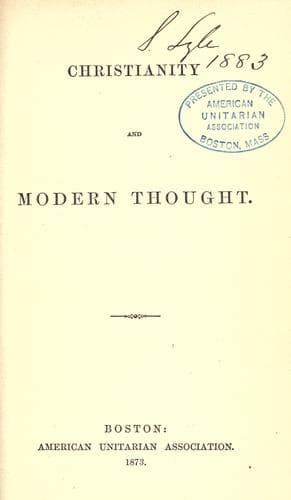
Christianity and Modern ThoughtPeabody, Andrew P. (Andrew Preston)
Religion
Christianity and Modern Thought
Peabody, Andrew P. (Andrew Preston)
Unitarianism
Christ is the Sun of righteousness. When reason, conscience, affection,
rule the world; when love and justice, and mild and tender views of life
and humanity, of God and Christ, displace the cruel terrors and
superstitions that have survived the social and political meliorations
of the age, we shall begin to see that love is the fulfilling of the
law, and liberty of thought the greatest friend of worship, the finest
result of Christ's coming, and the throne from which he commands the
whole human heart and history.
A TRUE THEOLOGY THE BASIS
OF
HUMAN PROGRESS.
By JAMES FREEMAN CLARKE.
The subject of the present lecture is "A True Theology the Basis of
Human Progress." And, in order to strike the key-note, and to indicate
the object at which I aim, I will read four or five passages from the
New Testament, which describe such a Theology in its spirit and root.
The Apostle Paul says:[1] "I count not myself to have apprehended: but
this one thing I do, forgetting those things which are behind, and
reaching forth unto those things which are before, I press toward the
mark." So he declares himself a Progressive Christian.
[Footnote 1: Phil. iii. 13.]
Again he says:[2] "We know in part, and we prophesy [or teach] in part.
But when that which is perfect is come, then that which is in part shall
be done away." So he declares that all intellectual statements, his own
included, are relative and provisional. He is here speaking, doubtless,
not of rational insights, but of the insight when elaborated by the
intellect into a statement; not of intuitional knowledge, but that which
comes from reflection. In regard to all such propositions, he would
accept the modern doctrine of the Relativity of Knowledge; thus cutting
up by the roots the poisonous weed of Bigotry.
[Footnote 2: 1 Cor. xiii. 9, 10.]
Again: "Brethren, be not children in understanding: howbeit, in malice
be ye children, but in understanding be men."[3] He thus requires and
authorizes a manly, intelligent Theology.
[Footnote 3: 1 Cor. xiv. 20.]
Again: "Who also hath made us able ministers of the New Testament; not
of the letter, but of the spirit: for the letter killeth, but the spirit
giveth life."[4] He here rejects the Theology of the letter, including
the doctrine of Literal Inspiration.
[Footnote 4: 2 Cor. iii. 6.]
Again: "God hath not given us the spirit of fear; but of power, and of
love, and of a sound mind."[5]
[Footnote 5: 2 Tim. i. 7.]
Public-domain text, read in full here on John Shaqi.
Reviews
Reviews
No reviews yet
Be the first to share your thoughts on this work.
Join the Discussion
Join the discussion
Sign in to leave a comment or review.
Sign InorCreate an account