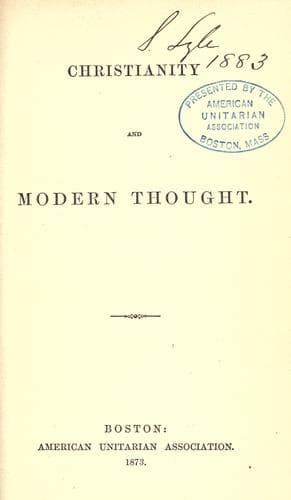
Christianity and Modern ThoughtPeabody, Andrew P. (Andrew Preston)
Religion
Christianity and Modern Thought
Peabody, Andrew P. (Andrew Preston)
Unitarianism
My Thesis to-night is not a truism; my argument is not unnecessary or
uncalled for. Nothing is more common than to undervalue the importance
of Theology; to regard it as having no bearing on life, no influence on
human progress, no causative power in regard to civilization. Mr.
Buckle, one of the most recent English philosophical historians,
contends that Theology is the result rather than the cause of national
character; that it is merely symptomatic of the condition of a people.
If they are in a good condition, they have a good Theology; if in a bad
condition, a bad one. He even thinks it owing to a mistaken zeal that
Christians try to propagate their religion, because he believes that
savages cannot become Christians. Civilization, Mr. Buckle supposes,
depends greatly upon soil, upon climate, upon food, upon the
trade-winds; but not much upon religious ideas. He says that, in
England, "theological interests have long ceased to be supreme." "The
time for these things has passed by." And this is also a very common
opinion among ourselves. Many reformers have a notion that we have done
with Theology, that we can do without it. Some men of science tell us
that Theology has nothing to do with the advance of civilization, but
that this comes from discovery in the sphere of physical science. But I
believe that the one thing which retards the progress of reform is a
false philosophy concerning God and man, a false view of God's ideas
concerning this world; and that the one thing needful for Human Progress
is a deeper, higher, broader view of God and his ways. And I hope to be
able to show some grounds for this opinion.
The religious instinct in man is universal. Some individuals and some
races possess more of it, and others less; but the history of mankind
shows that religion in some form is one of the most indestructible
elements of human nature. But whether this religious instinct shall
appear as faith or as fanaticism; whether it shall be a blind enthusiasm
or an intelligent conviction; whether it shall be a tormenting
superstition or a consoling peace; whether it shall lead to cruel
persecutions or to heavenly benevolence; all this, and more, depends on
Theology. Religion is a blind instinct: the ideas of God, man, duty,
destiny, which determine its development, constitute Theology.
The same law holds concerning Conscience and Ethics. Conscience in the
form of a moral instinct is universal in man. In every human breast
there is a conviction that something is right and something wrong; but
what that right and wrong is depends on Ethics. In every language of
man, there are words which imply ought and ought not, duty,
responsibility, merit, and guilt. But what men believe they ought to do,
or ought not to do,--that depends on the education of their conscience;
that is, on their Ethics.
Public-domain text, read in full here on John Shaqi.
Reviews
Reviews
No reviews yet
Be the first to share your thoughts on this work.
Join the Discussion
Join the discussion
Sign in to leave a comment or review.
Sign InorCreate an account