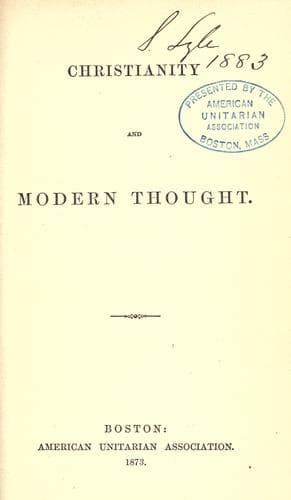
Christianity and Modern ThoughtPeabody, Andrew P. (Andrew Preston)
Religion
Christianity and Modern Thought
Peabody, Andrew P. (Andrew Preston)
Unitarianism
Conscience, like religion, is man's strength, and his weakness.
Conscience makes cowards of us all; but it is the strong-siding champion
which makes heroes of us all. Savages are cruel, pirates are cruel; but
they cannot be as cruel as a good man, with a misguided conscience. The
most savage heart has some touch of human kindness left in it, which
nothing can quite conquer,--nothing but conscience. That can make man as
hard as Alpine rock, as cold as Greenland ice. The torture-rooms and
_autos da fe_ of the Inquisition surpass the cruelties of the North
American Indian. The cruelties of instinct are faint compared with the
cruelties of conscience. Now what guides conscience to good or to evil?
Theology, in the form of Ethics, is the guide of conscience. For, as
soon as man believes in a God, he believes in the authority of his God
to direct and control his actions. Whatever his God tells him to do must
be right for him to do. Therefore religion in its inward form is either
a debasing and tormenting superstition or a glad faith, according to the
Theology with which it is associated. And religion, in its outward form,
is either an impure and cruel despotism or an elevating morality,
according to the idea of God and Duty which guide it; that is, according
to its associated Theology.
Some persons, like Lucretius, seeing the evils of Superstition, Bigotry,
and Fanaticism, and perceiving that these have their root in religion,
have endeavored to uproot religion itself. But could this be effected,
which is impossible, it would be like wishing to get rid of the
atmosphere, because it is sometimes subject to tempests, and sometimes
infected with malaria. Religion is the atmosphere of the soul, necessary
to the healthful action of its life, to be purified, but not renounced.
Every one has a Theology, who has even a vague idea of a God; and every
one has this who has an idea of something higher and better than
himself, higher and better than any of his fellow-men. The Atheist
therefore may have a God, though he does not call him so. For God is not
a word, not a sound: he is the Infinite Reality which we see, more or
less dimly, more or less truly, rising above us, and above all our race.
The nature of this ideal determines for each of us what we believe to be
right or wrong; and so it is that our Theology rules our conscience, and
that our conscience determines with more or less supremacy the tendency
and stress of our life.
Public-domain text, read in full here on John Shaqi.
Reviews
Reviews
No reviews yet
Be the first to share your thoughts on this work.
Join the Discussion
Join the discussion
Sign in to leave a comment or review.
Sign InorCreate an account