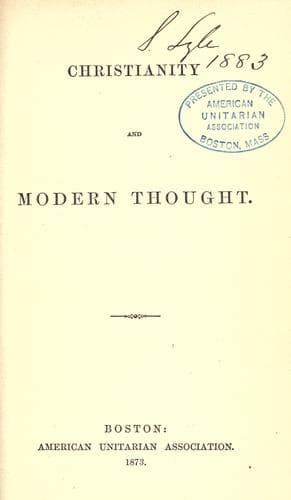
Christianity and Modern ThoughtPeabody, Andrew P. (Andrew Preston)
Religion
Christianity and Modern Thought
Peabody, Andrew P. (Andrew Preston)
Unitarianism
By a true Theology, I mean a manly Theology, as opposed to a childish
one; a free, as opposed to a servile one; a generous, as opposed to a
selfish one; a reasonable and intelligent Theology, as opposed to a
superstitious one.
By a true Theology, I mean one which regards God as a father, and man as
a brother; which looks upon this life as a preparation for a higher;
which believes that God gives us freedom, inspires our reason, and is
the author of whatever is generous, self-forgetting, and noble. I find
something of this Theology in all sects and churches; from the Roman
Catholic at one extreme, to the Universalists and Unitarians, the
Spiritualists and Come-outers, at the other. And the opposite, the false
Theology, dishonorable to God, degrading to man, I find in all sects,
and accompanying all creeds. And if I shall show, as truth compels me to
show, that certain parties and persons are specially exposed to danger
in one or another direction, I wish distinctly to state my belief that
sincere and earnest men continually rise above the contagion of their
position, and live untainted in an atmosphere which may have in it some
special tendency to disease.
One false idea in Theology, which opposes human progress, is that
Pantheistic view of the Deity, which loses sight of his personality, and
conceives of him as a blind, infinite force, pervading all Nature, and
carrying on the universe, but without intelligence and without love.
I know indeed that many views have been accused of being Pantheism which
are not. I do not believe in a God outside of the universe. I believe
that he is one "in whom we live, and move, and have our being," one
"from whom, and through whom, and to whom are all things,"--a perpetual
Creator, immanent in his world. But this view is quite consistent with a
belief in his personal being, in his intelligent, conscious, loving
purpose. Without such a belief, hope dies out of the heart; and without
hope mankind loses the energy which creates progress. Unless we have an
intelligent Friend who governs the universe, it will seem to be moving
blindly on toward no divine end; and this thought eats out the courage
of the soul.
In some poetical natures, as in the case of Shelley, this Pantheism
takes the form of faith in a spirit of beauty, or love, or intellectual
power, pervading all things. In more prosaic minds it becomes a belief
in law, divorced from love. It turns the universe into a machine, worked
by forces whose mutual action unfolds and carries on the magnificent
Cosmos. Often this view comes, by way of a reaction, against an
excessive Personality of Will. When the Christian Church speaks of the
Deity as an Infinite Power outside of the world, who creates it and
carries it on according to some contrivance, of which his own glory is
the end, it is perhaps natural that men should go to the other extreme
and omit person, will, and design from their conception of Deity. But
thus they encounter other and opposite dangers.
Public-domain text, read in full here on John Shaqi.
Reviews
Reviews
No reviews yet
Be the first to share your thoughts on this work.
Join the Discussion
Join the discussion
Sign in to leave a comment or review.
Sign InorCreate an account