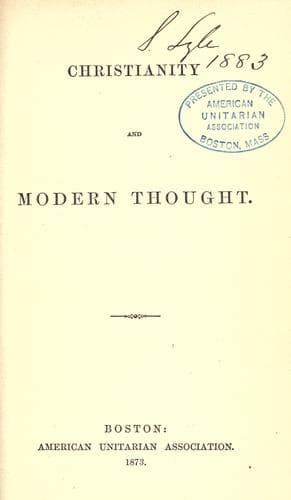
Christianity and Modern ThoughtPeabody, Andrew P. (Andrew Preston)
Religion
Christianity and Modern Thought
Peabody, Andrew P. (Andrew Preston)
Unitarianism
A gospel of mere law is no sufficient gospel. It teaches prudence, but
omits Providence. This utilitarian doctrine, which reduces every thing
to law,--which makes the Deity only a Great Order, not a Father or
Friend,--would soon put a stop to the deepest spring of human progress.
It takes faith and hope out of our life, and substitutes observation,
calculation, and prudence. But the case of Ecclesiastes and of Faust
teaches us what comes from knowledge emptied of faith. He who increases
such knowledge increases sorrow. The unknown, wonderful Father; the
divine, mysterious Infinite; the great supernatural power and beauty
above Nature, and above all,--these alone make life tolerable. Without
this brooding sense of a Divine love, of a Heaven beyond this world, of
a Providence guiding human affairs, men would not long have the heart to
study, because all things would seem to be going nowhere. Without such a
Heavenly Friend to trust, such an immortal progress to hope, all things
would seem to revolve in a circle. Not to believe in something more than
a God of Law is to be without God in the world, is to be without hope.
And hope is the spring of all progress, intellectual progress as well as
all other. Intellect, divorced from faith, at last kills intellect
itself, by destroying its inner motive. It ends in a doctrine of
despair, which cries continually, "What is the use?" and finds no
answer. And so the soul dies the only death the soul can die,--the death
of torpor and inaction.
Another false idea in Theology, which interferes with human progress, is
that of ecclesiastical authority in matters of faith and practice. When
the Church comes between the soul and God, and seeks to be its master
rather than its servant, it takes from it that direct responsibility to
God, which is one of the strongest motives for human effort. I know that
this has always been done from a sincere desire, at any rate in the
beginning, to save men from apparent dangers. The Church has assumed
authority, in order to do good with it. It has commanded men not to
think for themselves, lest they should err. But God has meant that we
should be liable to error, in order that we should learn to avoid it by
increased strength. Therefore Christ said, "Be not called Rabbi; be not
called Masters, and call no man father on earth." His church, and his
apostles, and he himself are here, not to be masters of the soul, but to
be its servants.
Public-domain text, read in full here on John Shaqi.
Reviews
Reviews
No reviews yet
Be the first to share your thoughts on this work.
Join the Discussion
Join the discussion
Sign in to leave a comment or review.
Sign InorCreate an account