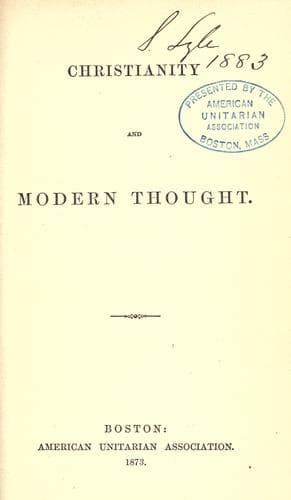
Christianity and Modern ThoughtPeabody, Andrew P. (Andrew Preston)
Religion
Christianity and Modern Thought
Peabody, Andrew P. (Andrew Preston)
Unitarianism
The Roman Catholic Church is a great organization, which has gradually
grown up, during a thousand years, the object of which has been to
educate men in Christian faith and Christian conduct. It has sincerely
endeavored to do this. But, unfortunately, it took a narrow view of
Christian education; supposing that it meant instruction and guidance,
restraint and tuition, but not development. It has magnified its own
authority, in order to produce docility in its pupils. It has not
allowed them freedom of inquiry nor liberty of conscience. It has not
said, like Paul, "Be not children in understanding;" on the contrary, it
has preferred to keep them children, so as to guide them more easily. It
has not said, with Paul, "Stand fast in the liberty wherewith Christ has
made you free;" for it has come to hate the very name of liberty. What
is the result? You may read it to-day in France, where, as Mr. Coquerel
tells us, that Church has prevented the steady development of free
institutions. It has always supported the principle of authority in the
State, as the natural ally of authority in the Church. There are so few
republicans in France to-day, because the people have been educated by
the Church to blind submission. The priests are not to blame, the people
are not: it is the Roman Catholic Theology which is to blame. That
Theology teaches that the soul is saved by the reception of external
sacraments, and not by vital, independent convictions of truth.[6]
[Footnote 6: The proof of this may be amply found in the famous
Encyclical and Syllabus of Pius IX., Dec. 8th, 1864. In the Syllabus he
denounces as errors such propositions as the following:--
That "every man is free to embrace and profess that religion which
guided by the light of reason, he holds to be true." § 15.
That "one may well hope, at least, for the eternal salvation of those
who are in no wise in the true Church of Christ." § 17.
That "the Church has no power to employ force." § 24.
That "men emigrating to Catholic countries should be permitted the
public exercise of their own several forms of worship." § 78.
That "the Roman Pontiff can and ought to reconcile and harmonize himself
with progress, with liberalism, and with modern civilization." § 80.]
Public-domain text, read in full here on John Shaqi.
Reviews
Reviews
No reviews yet
Be the first to share your thoughts on this work.
Join the Discussion
Join the discussion
Sign in to leave a comment or review.
Sign InorCreate an account