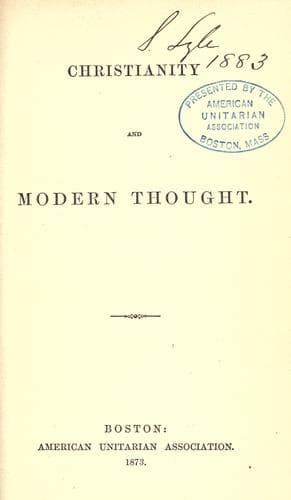
Christianity and Modern ThoughtPeabody, Andrew P. (Andrew Preston)
Religion
Christianity and Modern Thought
Peabody, Andrew P. (Andrew Preston)
Unitarianism
Some years ago the American Bible Society appointed a committee of the
most learned scholars, from all Orthodox denominations, to correct the
text and the translation of our common English Bible, so as to make it
conform to the true Hebrew and Greek text. They were not to make a new
translation, but merely to correct palpable, undoubted errors in the old
one. They did their work; printed their corrected Bible; laid it before
the Bible Society,--_and that Society refused to adopt it_. They had not
the slightest doubt of its superior correctness; but they feared to make
any change, lest others might be called for, and lest the faith of the
community might be disturbed in the integrity of the Scriptures. Jesus
had promised them the Holy Spirit to lead them into all truth, to take
of his truth and show it to them; but they did not believe him. They
preferred to anchor themselves to the words chosen by King James's
translators than to be led by the Spirit into any new truth. So it is
that "the letter killeth." It stands in the way of progress. It keeps us
from trusting in that ever-present Spirit which is ready to inspire us
all to-day, as it inspired prophets and apostles of old. It is an
evidence not of faith, but of unbelief.
Thus, this false idea in Theology, that inspiration rests in the letter
of a book or a creed rather than in its spirit, is seen to be opposed to
human progress.
And then there is another Theology which is opposed to human progress.
It is the Theology of Fear. It speaks of hell rather than of heaven; it
seeks to terrify rather than to encourage; it drives men by dread of
danger rather than leads them by hope. Its ruling idea is of stern,
implacable justice; its God is a God of vengeance, who cannot pardon
unless the full penalty of sin has been borne by some victim; whose
mercy ceases at death; who can only forgive sin during our short human
life, not after we have passed into the other world. To assuage his
anger, or appease his justice, there must be devised some scheme of
salvation, or plan of redemption. He cannot forgive of pure, free grace,
and out of his boundless love.
Public-domain text, read in full here on John Shaqi.
Reviews
Reviews
No reviews yet
Be the first to share your thoughts on this work.
Join the Discussion
Join the discussion
Sign in to leave a comment or review.
Sign InorCreate an account