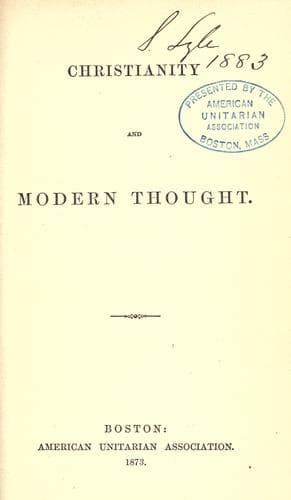
Christianity and Modern ThoughtPeabody, Andrew P. (Andrew Preston)
Religion
Christianity and Modern Thought
Peabody, Andrew P. (Andrew Preston)
Unitarianism
But there is another movement, which I regard with equal interest, and
which promises in fact, to go deeper than any thing else we can do. I
allude to those Unions, in which, I think the city of Providence leads
the way: and in which New Bedford, Worcester, and Brooklyn have followed
the example. These associations provide a public room or rooms, well
lighted and warmed, for those who will, to resort to them; but
especially for the young, who most need good culture, entertainment and
encouragement; and in these rooms are found books, pictures, games, and
music perhaps; and classes for regular instruction may be formed, and
lectures occasionally given, or discussions held; in fact, whatever will
contribute to the general improvement and to the pleasant and profitable
passing of social evenings, may be introduced. This kind of institution
is especially adapted to our smaller cities; and may be extended to our
country villages. Our people in the country, live too much apart and
alone; and besides the direct advantages of these gatherings together, a
mutual acquaintance and a kindly feeling would be promoted, which are of
scarcely less importance.
Let me add that there is a new ideal of life, which, I think, is slowly
arising among us; and which, when it is fully carried out, I believe,
will make an impression upon society, never before seen in the world.
This is the idea of mutual helpfulness; of every man's living not to
himself, but to God, in loving and helping his kind. Helpfulness, I
say--that which Mr. Ruskin describes as the most glorious attribute of
God himself; and which has so seized upon his imagination, that he
ventures to substitute for "Holy, holy, holy is the Lord," Helpful,
helpful, helpful, is the Lord God Almighty! This will not do; but it
indicates a glorious tendency of modern thought. The old ideal of life
has been, to get together the means of comfort and enjoyment; to get
wealth, to get a fine house, to get luxuries for wassail and feasting,
or to get books and pictures; and then to sit down and enjoy all this
good estate, and transmit it to fortunate heirs, with little thought of
others--with some charities perhaps, but without taking into heart or
life, the common weal, happiness and improvement of all around.
Public-domain text, read in full here on John Shaqi.
Reviews
Reviews
No reviews yet
Be the first to share your thoughts on this work.
Elsewhere in the archive
Join the Discussion
Join the discussion
Sign in to leave a comment or review.
Sign InorCreate an account