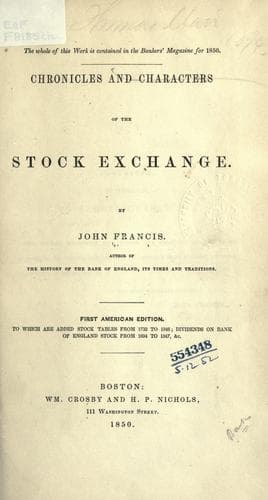
Chronicles and characters of the stock exchangeFrancis, John, of the Bank of England
History
Chronicles and characters of the stock exchange
Francis, John, of the Bank of England
Speculation; Stock Exchange (London, England)
Few trials, which were not for life, have excited so much interest
in the city, as that in which Benjamin Walsh—a member of the senate,
a member of the Stock Exchange, and a confessed felon—stood at the
bar of the Old Bailey, on the charge of defrauding Sir Thomas Plomer.
The bench was crowded with the rank and respectability of the city.
The melancholy appearance of the prisoner, his grave bearing, and
dejected countenance, excited the interest of the spectators, and
spoke the regret of the culprit.
In 1811, Sir Thomas informed his broker, Mr. Benjamin Walsh, M. P.,
that, having bought an estate, it would be necessary to sell out a
large amount of stock to complete the purchase. Mr. Walsh advised
Sir Thomas not to sell directly, as there was every prospect of the
funds rising; and, the title of the estate not being complete, this
advice was complied with. About the middle of November, however, Mr.
Walsh changed his opinion, and repeatedly urged Sir Thomas to sell
his stock, alleging his belief that the price would fall. Again the
broker’s suggestion was complied with; but, as it was sold before
the money was required for the estate, it was recommended by the
prisoner that, to prevent it from lying idle, exchequer-bills should
be purchased with the proceeds. Sir Thomas again consented, and gave
a check amounting to £22,000 to Mr. Walsh, who promised to lodge
the notes at Goslings’, the bankers to Sir Thomas, and hand the
latter their receipt. In the evening, however, he presented their
acknowledgment for only £6,000, and making some excuse for not having
paid in the remaining exchequer-bills, promised to deliver them on
the following day; adding that, as he had not settled for them, he
had repaid the difference to the account of Sir Thomas. The latter,
on his way home, called at his bankers’, and found that, though
the £6,000 in exchequer-bills had been deposited, the check of Mr.
Walsh for the £16,000 had been received too late for presentation.
No suspicion was, however, attached to the transaction until next
day, when the check was refused payment. Sir Thomas was immediately
informed, and an inquiry instituted. It was soon found that the money
thus iniquitously gained, had been disposed of in paying his brother
£1,000, in purchasing £11,000 American stock, and in investing £500
in Portuguese doubloons. The prisoner was found guilty; but certain
points, reserved for the judges, being interpreted favorably, he was
discharged from Newgate, and expelled from the House of Commons.
Public-domain text, read in full here on John Shaqi.
Reviews
Reviews
No reviews yet
Be the first to share your thoughts on this work.
Elsewhere in the archive
Join the Discussion
Join the discussion
Sign in to leave a comment or review.
Sign InorCreate an account