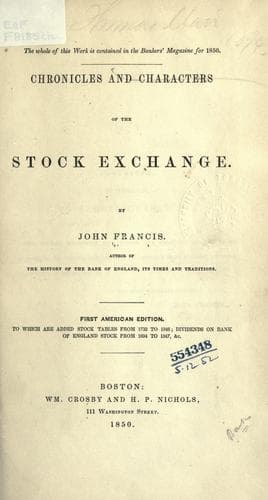
Chronicles and characters of the stock exchangeFrancis, John, of the Bank of England
History
Chronicles and characters of the stock exchange
Francis, John, of the Bank of England
Speculation; Stock Exchange (London, England)
News was not then so frequent,
information was not so widely diffused; and the document was credited
much longer than it would have been a quarter of a century later. It
deserves to be mentioned as a curiosity, that the forgery was not
attributed to members of the Stock Exchange, but to a pair of “state
speculators,” assisted by “members of the lower House.” But though
it was not caused by them, they felt its effect in the fluctuating
price, and several were ruined by the ingenious device of these
“state speculators” and “members of the lower House.”
Among the names conspicuous in the city for character and capacity,
stands that of the great political economist, David Ricardo, who, at
the early age of fourteen, was introduced by his father, a Hebrew
of the Hebrews, to the mysteries of the Stock Exchange. The mind
of the younger Ricardo was of an inquiring character. He began to
study the principles of the creed in which he had been educated. The
result was his secession from the faith of the ancient people, and
his abandonment to his own resources by his father. Those resources
were small; but his conduct and character had interested the members
of Capel Court, and, to their honor, with a liberality which not
unfrequently distinguishes them, the oldest and most influential
came to his assistance. The extraordinary powers of Mr. Ricardo were
soon developed in the acquisition of a considerable fortune; and,
having hitherto employed but little time in study, he amply and nobly
redeemed his lost hours. At twenty-five he commenced mathematics, and
with great application studied chemistry and mineralogy, fitted up a
laboratory, formed a collection of minerals, and bestirred himself
with all the energy of his character. These sciences, however, he
soon abandoned, and, having accidentally become acquainted with Adam
Smith’s “Wealth of Nations,” he employed his great thought upon the
subject of political economy, in which he soon became distinguished.
He led the van in the bullion controversy; his principles were those
on which the present bank charter is founded; and, in 1817, he
published that great work on his favorite science so familiar to the
commercial reader.
His reputation preceded him to the senate; and his opinions on the
above subjects were deferred to with respect. When Mr. Peel’s bill
was introduced, in 1819, his name was called for from all sides
of the House; and, in 1823, David Ricardo, an acute, patient, and
comprehensive thinker, a firm and faithful friend, and an honor
to the body of which he was a member, died, at the early age of
fifty-two.
Public-domain text, read in full here on John Shaqi.
Reviews
Reviews
No reviews yet
Be the first to share your thoughts on this work.
Elsewhere in the archive
Join the Discussion
Join the discussion
Sign in to leave a comment or review.
Sign InorCreate an account