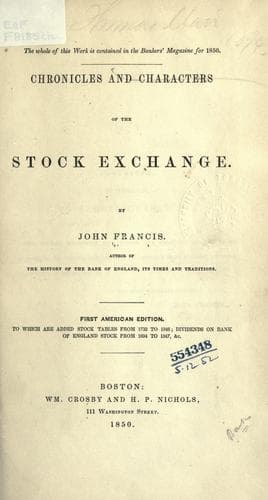
Chronicles and characters of the stock exchangeFrancis, John, of the Bank of England
History
Chronicles and characters of the stock exchange
Francis, John, of the Bank of England
Speculation; Stock Exchange (London, England)
Almost every one professes to consider the debt as a drain upon
the resources of the nation; as a nightmare upon the chests of the
people; and as a millstone which will sink England below her proper
position. Most of our political writers affect this view. All our
alarmists make it their theme. Hume wrote,—“Either the nation must
destroy public credit, or public credit must destroy the nation.”
Sir Robert Walpole said,—“When the debt reaches 100 millions, the
nation will be bankrupt.” In 1735, Lord Hervey, in his memoir of
George II., remarked,—“I do not see how it would be possible for the
country, on any exigence, or for the support of the most necessary
war, to raise one million a year more than it now raises”; and in
1777 the third earl wrote as a note,—“What would my father have said
had he seen seventeen millions raised in a year?” Lord Bolingbroke
declared the debt was sinking England into the gulf of inevitable
bankruptcy. Cobbett was perfectly rabid in his attacks on those whom
he invariably classed as Jews and fundholders, predicted the ruin of
England in half a century, and proposed, in 1832, a plan which would
have ceased the interest on the national debt in twenty-seven years,
and have classed England among the repudiators.
Adam Smith thought that the practice of funding had gradually
weakened every state which had adopted it. Paine openly predicted the
Bank and the government would perish together in a few months. Mr.
Tierney said, in 1817, such a state of things could not go on. Sir
James Graham proposed, in 1827, a reduction of thirty per cent. Mr.
Baines thought it might be ultimately necessary to make a general
contribution to extinguish a large portion of the debt; and the late
Earl Grey talked in early life of “taking the bull by the horns”;
although he failed to fulfil in his age the promise of his youth.
If prophecies such as these have been plentiful, the following
extract, at once a picture and illustration of the period when the
nation first commenced to borrow, will prove that other views are
entertained by many, and that there is a large class who, however
they may deprecate the great evils arising from the debt, consider
that it has been beneficial to the interests of England.
Public-domain text, read in full here on John Shaqi.
Reviews
Reviews
No reviews yet
Be the first to share your thoughts on this work.
Elsewhere in the archive
Join the Discussion
Join the discussion
Sign in to leave a comment or review.
Sign InorCreate an account