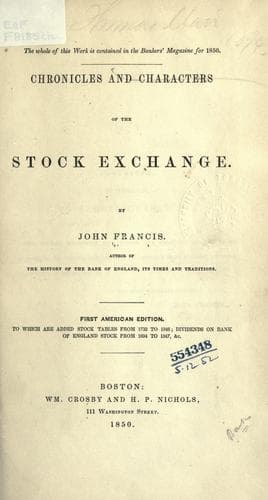
Chronicles and characters of the stock exchangeFrancis, John, of the Bank of England
History
Chronicles and characters of the stock exchange
Francis, John, of the Bank of England
Speculation; Stock Exchange (London, England)
“The era of the Revolution is chiefly remarkable for the new dynasty
having taught the government how to raise taxes in the country, and
thus brought England to take the place to which she was entitled
in the scale of nations, by bringing the vast national resources
to bear upon the national struggles. That which the Stuarts never
could effect by appeal to honor, spirit, or patriotism, William and
Anne soon accomplished by bringing into play, and enlisting on their
side, different and less creditable motives. They no longer bullied
the House of Commons, they bribed it; and, strange to say, it is to
the entire success of the gigantic system of borrowing, expending,
and corrupting, which they introduced, and which their successors
so faithfully followed, that the subsequent greatness of England
is mainly to be ascribed. It was the system of managing the House
of Commons by loans, good places, and bribes, which provided the
sinews of war, and prepared the triumphs of Blenheim and Ramilies.
William tripled the revenue, and gave so much of it to the House of
Commons that they cordially agreed to the tripling. He spent largely;
he corrupted still more largely; he made the national interest in
support of taxation more powerful than those operating to resist it.
The memoirs recently come out give details of corruption so barefaced
and gross, that they would exceed belief if their frequency, and the
testimony to their authenticity from different quarters, did not defy
disbelief.”
It is now known, that when Walpole’s ministerial supporters were
invited to his ministerial dinner, each found a £500 note under his
napkin.
It is one great evil of the present age, that it persists in
regarding the debt as perpetual. Immediately the expenditure is
exceeded by the revenue, there is a demand for the reduction of
taxation. We, a commercial people, brought up at the feet of
McCulloch, with the books of the national debt as a constant study,
with the interest on the national debt as a constant remembrancer,
persist in scoffing at any idea of decreasing the encumbrance; and
when a Chancellor of the Exchequer proposes a loan of eight millions,
we growl and grumble, call it charitable, trust for better times, and
read the opposition papers with renewed zest.
There is no doubt that the resources of the nation are equal to far
more than is now imposed; but it can only be done by an efficient
revision of our taxation; and this will never be effected till the
wolf is at the door. A war which greatly increased our yearly imposts
would, with the present system, crush the artisan, paralyze the
middle class, and scarcely leave the landed proprietor unscathed. The
convertibility of the note of the Bank of England would cease; and
it would be impossible to preserve the charter of Sir Robert Peel in
its entirety, while twenty-eight millions were claimable yearly in
specie, and the gold of the country went abroad in subsidies.
Public-domain text, read in full here on John Shaqi.
Reviews
Reviews
No reviews yet
Be the first to share your thoughts on this work.
Elsewhere in the archive
Join the Discussion
Join the discussion
Sign in to leave a comment or review.
Sign InorCreate an account