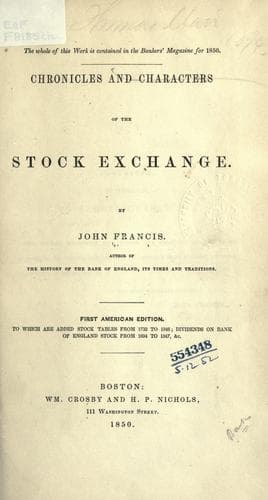
Chronicles and characters of the stock exchangeFrancis, John, of the Bank of England
History
Chronicles and characters of the stock exchange
Francis, John, of the Bank of England
Speculation; Stock Exchange (London, England)
It is not unworthy of remark, that many of the greatest efforts of
intellect are within the scope of the writer; as most of those works
which have from time to time benefited the world, both socially and
physically, have been assisted by the money power of England. Nor
will the inquirer be backward in comparing the singular difficulties
with which all inventions requiring great capital contended in the
last century, with the remarkable facility which marks their progress
in the present, if they fairly promise, as most grand inventions do,
to interest the entire community, and pay ten per cent.
The annals of invention have ever been those of opposition; and the
history of locomotion has been singularly illustrative of this.
The journey from city to city, and from county to county, was once
painfully slow. It is a subject of ridicule in the present day. A
great feature with novelists, a few years ago, was to represent the
incidents of a long inland journey. The memory of the reader will at
once recur to “Tom Jones,” to “Humphrey Clinker,” and to the humorous
scene drawn by the modern master of fiction in the opening chapter
of “The Antiquary,” as some illustration of the liabilities of the
traveller.
It is easier to ridicule than to reason, and safer to prophesy defeat
than to predict success. The minds of the mass generally depreciate
that which is beyond them; some fancy that they elevate themselves
by lowering others; while the many, who bigotedly view all change
as evil, doggedly refuse to acknowledge the good till they reap
the fruit; and it is probable that the loudest grumbler in the
railway-carriage of the present day was the loudest declaimer against
locomotives a quarter of a century ago.
When the turnpikes were extended from the metropolis to the country,
many of the counties petitioned Parliament against so heinous an
attempt upon vested rights. The rustic gentleman grew eloquent
upon the subject of rendering London accessible, and drew pictures
of desolation, in which the grass was to grow in the streets, in
which rents were to be reduced, cultivation was to be lowered,
and the producer ruined. The toll-bars of the newly-made roads in
the eighteenth century were torn to the ground, and the blood of
a prejudiced people was shed in their defence. The first “flying
coaches,” though six days were employed to do that which is now
done in six hours, were met with invectives. It was said that they
would be fatal to the breed of horses and the art of horsemanship;
that saddlers and spurriers would be ruined; that the inns would be
abandoned; and, above all, the Thames, as the great nursery of our
seamen, would be destroyed. The post, that grand social benefit,
was denounced, in Charles II.’s reign, as a Popish contrivance; and
the first attempt to light the streets—an attempt which only made
darkness visible—was vehemently attacked.
Public-domain text, read in full here on John Shaqi.
Reviews
Reviews
No reviews yet
Be the first to share your thoughts on this work.
Elsewhere in the archive
Join the Discussion
Join the discussion
Sign in to leave a comment or review.
Sign InorCreate an account