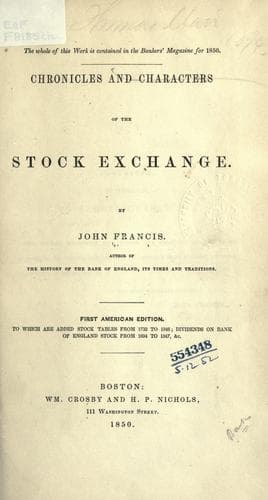
Chronicles and characters of the stock exchangeFrancis, John, of the Bank of England
History
Chronicles and characters of the stock exchange
Francis, John, of the Bank of England
Speculation; Stock Exchange (London, England)
The reign of William was productive of all modes and methods of
borrowing. Short and long annuities, annuities for lives, tontines,
and lotteries, alike occupied his attention. The former are still in
existence, the two latter have fallen to decay. The lotteries have
been expunged from the statute-book, and their evils will be fully
developed at a fitting period; while to the brain of a Neapolitan,
and the city of Paris, William was indebted for the knowledge of the
tontine. Lorenzo Tonti, in the middle of the seventeenth century,
with the hope of making the people of France forget their discontents
in the excitement of gambling, suggested to Cardinal Mazarin the idea
of annuities, with the benefit to the survivors of those incomes
which fell by death. The idea was approved by the Cardinal and
allowed by the court. Parliament, however, refused to register the
decree, and the scheme failed. Tonti again endeavoured to establish
a society on this plan, and to build by its means a bridge over the
Seine; but the unfortunate inventor christened it Tontine, and not
a man in Paris would trust his money to a project with an Italian
title. A complete enthusiast, he allowed Paris no rest on his
favorite theme, and proposed to raise money for the benefit of the
clergy in the same way. The Assembly reported on the scheme, and
the report contained all that could flatter the projector’s vanity,
but refused a permission to act on it; and again it was abandoned.
The idea, however, which could not be carried out for the people,
which was refused for the benefit of the city, and not allowed for
the clergy, was claimed as a right for the crown; and in 1689, Louis
XIV. created the first tontine to meet his great expenses. From this
period they became frequent; and William was too determined to humble
the pride of his rival, not to avail himself of this among other
modes of raising funds.[1]
The moneyed interest—a title familiar to the reader of the present
day—was unknown until 1692. It was then arrogated by those who saw
the great advantage of entering into transactions in the funds
for the aid of government. The title claimed by them in pride was
employed by others in derision: and the purse-proud importance of men
grown suddenly rich was a common source of ridicule.
Public-domain text, read in full here on John Shaqi.
Reviews
Reviews
No reviews yet
Be the first to share your thoughts on this work.
Join the Discussion
Join the discussion
Sign in to leave a comment or review.
Sign InorCreate an account