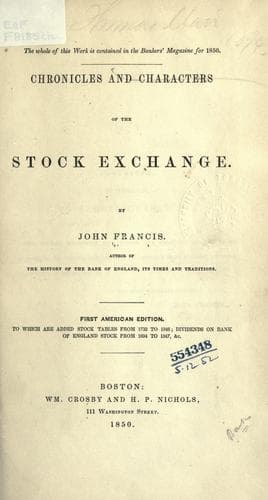
Chronicles and characters of the stock exchange — John Shaqi
Chronicles and characters of the stock exchangeFrancis, John, of the Bank of England
History
Chronicles and characters of the stock exchange
Francis, John, of the Bank of England
Speculation; Stock Exchange (London, England)
Wealth rapidly acquired has been invariably detrimental to the
manners and the morals of the nation, and in 1692 the rule was as
absolute as now. The moneyed interest, intoxicated by the possession
of wealth which their wildest dreams had never imagined, and incensed
by the cold contempt with which the landed interest treated them,
endeavoured to rival the latter in that magnificence which was one
characteristic of the landed families. Their carriages were radiant
with gold; their persons were radiant with gems; they married the
poorer branches of the nobility; they eagerly purchased the princely
mansions of the old aristocracy. The brush of Sir Godfrey Kneller,
and the chisel of Caius Cibber, were employed in perpetuating their
features. Their wealth was rarely grudged to humble the pride of a
Howard or a Cavendish; and the money gained by the father was spent
by the son in acquiring a distinction at the expense of decency. They
were seized upon by the satirist and the dramatist as a new object of
ridicule; and under various forms they have become a stage property.
The term which they had chosen to distinguish them became a word of
contempt; and the moneyed class was at once the envy and the laugh
of the town. Nor was it until that interest became a great and most
important one, that the term assumed its right meaning, or that the
moneyed contended with the landed interest on a more than equal
footing. The former have always clung to the house of Brunswick; the
latter have often used their exertions against it. In time, however,
the moneyed became a landed interest, and vied in taste as well as
magnificence with the proudest of England’s old nobility. Among these
was Sir Robert Clayton, director of the Bank, whose banqueting-room
was wainscoted with cedar, whose villa was the boast of the
Surrey hills, whose entertainments imitated those of kings, whose
judicious munificence made him the pride of that great city to the
representation of which he was called by acclamation. But there were
other and less reputable directors of the great Bank; and a pamphlet,
published shortly afterwards, drew public attention to acts which
either prove that morality in one commercial age is immorality in the
next, or that some of the governors of the corporation were wofully
deficient in the organ of conscientiousness.
Public-domain text, read in full here on John Shaqi.
Reviews
Reviews
No reviews yet
Be the first to share your thoughts on this work.
Join the Discussion
Join the discussion
Sign in to leave a comment or review.
Sign InorCreate an account