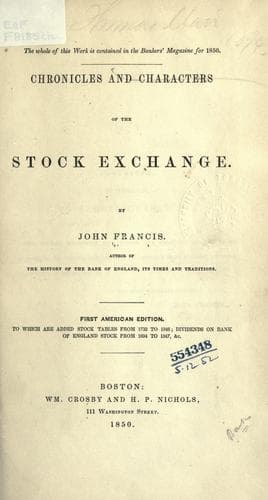
Chronicles and characters of the stock exchangeFrancis, John, of the Bank of England
History
Chronicles and characters of the stock exchange
Francis, John, of the Bank of England
Speculation; Stock Exchange (London, England)
The case of Dr. Bowring was equally memorable. The sum of £25,000
had been allotted to this gentleman, and his horror and alarm may be
conceived when he saw it decline to a discount of eighteen per cent.
The doctor was very vehement in his applications. He represented
his great services; he worried the unhappy deputies; he placed his
cause before them in such vivid colors, that the stock, which had
fallen to eighteen per cent., was taken off his hands at only ten
per cent. loss. When it rose to par, he imitated his illustrious
fellow-laborer, and applied to have it returned. He was reminded that
he had parted with his stock; but the doctor, blessed with a short
memory, professed to have forgotten the very circumstance which it
had cost him an agony to compass. The letters of Dr. Bowring were
somewhat naïve. “I am still the holder of a considerable sum, and I
hope we shall see the loan rise to a good price for _the benefit of
every body_.” “_As the difference to me is a serious one, and to the
Greek government of little importance_, I hope you will oblige me by
allowing the return of the £25,000 scrip.”
There were statements and counter-statements in the journals; there
were pleadings and special pleadings in the magazines; there were
eloquent papers in the Westminster Review, to prove it was all right;
and there were powerful articles in the Quarterly, to prove it was
all wrong. “The economical Mr. Hume’s over-anxiety for scrip,” said
the latter, “the erudite Mr. Bowring’s various translations of stock,
the romantic partiality displayed for per cents by Orlando, have
been sufficiently discussed. Public opinion is quite made up in all
these details; and when the sacred cause of insurrection all over
the world shall again need a loan, the suffering patriots may allow
such statesmen to plead their cause, to clamor about their wrongs,
to weep over their miseries, to dabble in metaphysical, poetical,
and periodical departments, provided they do not meddle with the
pecuniary.”
A poem was extensively circulated, in ridicule of the affair, and
with an extract, the present account of the Greek loan is concluded:—
“O, when the bubble burst, ’t were sweet to mark
How cash and cant roared in alternate bark!
Here, ‘Missolonghi’s fall the spirit shocks’;
There, ‘Were that all,—but, O, the price of stocks!’
Here, ‘Brimful now is misery’s fatal cup,
The Turks have blown another fortress up!’
There, ‘Forts blown up? I’ve heavier news to tell;
The scrip, the scrip will be blown up as well!’
One cries, ‘The cause is lost!’ Another, ‘Zounds,
Who cares? I’ve lost my four-and-fifty pounds!’
Snuffles a saint, ‘I sorrow for the cross;
But nineteen discount is a serious loss.’
Whispers a sinner, ‘Why, the thing must fall;
But, ’t was a very pretty bubble after all!’”
Public-domain text, read in full here on John Shaqi.
Reviews
Reviews
No reviews yet
Be the first to share your thoughts on this work.
Elsewhere in the archive
Join the Discussion
Join the discussion
Sign in to leave a comment or review.
Sign InorCreate an account