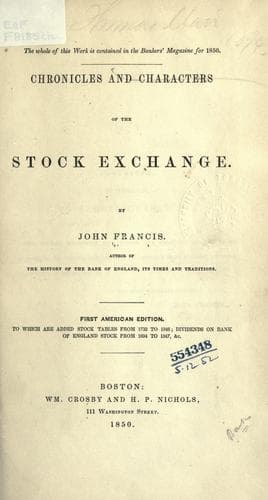
Chronicles and characters of the stock exchangeFrancis, John, of the Bank of England
History
Chronicles and characters of the stock exchange
Francis, John, of the Bank of England
Speculation; Stock Exchange (London, England)
The following extract from Dr. Shelton Mackenzie’s “Partnership en
Commandite,” will form a fitting conclusion to the history of the
foreign loan excitement of 1825:—“Upwards of twenty-five millions
sterling were advanced in foreign loans, of which the show of paying
even the smallest dividend is scarcely kept up. Taking into account
the foreign loans, the investments in foreign funds, and the amount
advanced for foreign railways, about 100 millions sterling have gone
out of this country in the last twenty-five years. Three fourths of
this immense capital are irretrievably sunk.”
“I always,” said a retired financier of great capacity, “tell my
brokers to sell when the Whigs come into office, as they are sure
to lower consols with the credit of the country.” To intimate that
the Whigs were in office in 1831, is to say that their financial
difficulties were great. In this year curiosity was raised to know
the mode which the Chancellor would adopt to meet the deficient
revenue; and great was the surprise of the commercial public when
this gentleman boldly proposed, that, upon every transfer of funded
property, a tax of 10_s._ per cent. should be placed. From this
source he reckoned upon £800,000. It need hardly be said, that
the city received the proposal with such a burst of contemptuous
derision, that the unhappy Chancellor in a very short time consented
to abandon it.
In the following year the reform question startled many capitalists,
and large sales of funded property were made. Some, alarmed at
what appeared more like revolution than reform, when they heard
of “moral demonstrations” to be made by two hundred and fifty
thousand determined men; of soldiers detained in their quarters on
Sunday, to sharpen their swords; of mutiny among the Scots Greys;
of business suspended, and all the usual accompaniments of great
changes,—determined to sell securities which a day might render
worthless. The dealers narrowed their personal operations to a limit
consistent with safety; while others sold all, and purchased in
foreign funds. The feeling of these individuals was evinced by the
fact, that they bought chiefly in Russian funds, as affording greater
security.
Public-domain text, read in full here on John Shaqi.
Reviews
Reviews
No reviews yet
Be the first to share your thoughts on this work.
Elsewhere in the archive
Join the Discussion
Join the discussion
Sign in to leave a comment or review.
Sign InorCreate an account