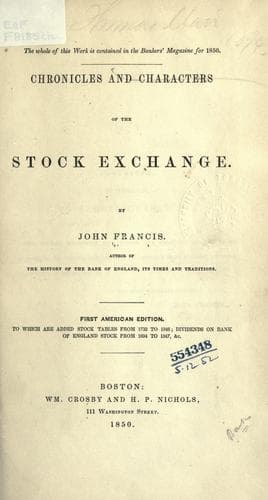
Chronicles and characters of the stock exchangeFrancis, John, of the Bank of England
History
Chronicles and characters of the stock exchange
Francis, John, of the Bank of England
Speculation; Stock Exchange (London, England)
For a considerable number of years, many, who, not members of the
Stock Exchange, yet dealt in its securities and acted as brokers,
employed the Rotunda of the Bank of England for their transactions.
The broker who had no counting-house made it his place of business;
and his clients waited there until the transfer was ready, or the
business was arranged. As a theatre for jobbing, it interfered with
the Bank; but Mr. Curtis, governor of that establishment, turned them
out somewhat unceremoniously; and, when he afterwards failed in
business, so great was his unpopularity with those he had summarily
dismissed, that the news of his bankruptcy was received with three
cheers by the members of the Stock Exchange. It is impossible to
give a fact more suggestive of the manners of the men from whom so
disgraceful a token of triumph emanated.
The great increase in the business of the foreign funds called for
additional space; a room was, therefore, opened for the dealers; and
from this arose the Foreign Stock Exchange, which for some years
maintained a separate committee, chairman, and deputy-chairman. It
now forms part of the edifice known as the Stock Exchange.
The number of members varies. It has reached 1,000, it has descended
to 400, and it now numbers about 800.
CHAPTER XVI.
_Sketch of the Life of Rothschild.—Comes to England.—Introduction
of Foreign Loans.—Large Purchases.—Anecdotes concerning
Rothschild.—His Difficulties and Annoyances.—His Death and
Burial.—Last Crisis on the Stock Exchange._
The eminent abilities of Nathan Meyer Rothschild were inherited
from his father, who, educated for the synagogue, distinguished
himself as a financier, and, though engaged in the uncongenial sphere
of a counting-house, became a learned archæologist. Frankfort,
Berlin, Vienna, London, Naples, and Paris, have alike witnessed the
prescience of the money-making Rothschilds; and it is reported that
the first great success of Meyer Anselm, the father of the house,
originated in the possession of the fortune of the Landgrave of Hesse
Cassel, which he saved from the grasp of Napoleon, and which must
have been to a commercial man of the utmost importance.[7]
Public-domain text, read in full here on John Shaqi.
Reviews
Reviews
No reviews yet
Be the first to share your thoughts on this work.
Elsewhere in the archive
Join the Discussion
Join the discussion
Sign in to leave a comment or review.
Sign InorCreate an account