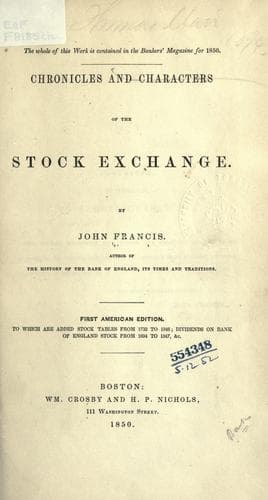
Chronicles and characters of the stock exchangeFrancis, John, of the Bank of England
History
Chronicles and characters of the stock exchange
Francis, John, of the Bank of England
Speculation; Stock Exchange (London, England)
By his own report, Nathan Meyer Rothschild came to Manchester because
Frankfort was too small for the operations of the brothers, although
the immediate cause was some offence to a customer; and it is
characteristic of the intrepidity of the man, that, with scarcely any
hesitation, and with an absolute ignorance of the English language,
he came to the country in which he realized such great results. On
Tuesday he told his father he would go to England, and on Thursday
he started. With £20,000 he commenced his career; and in a short
time his capital was trebled. At Manchester he soon saw there were
three profits to be made,—in the raw material, the dyeing, and the
manufacturing. It need hardly be added, that his great mind had
stomach for them all, and that, having secured the three, he sold
goods cheaper than any one else. This was the foundation of that
colossal fortune which afterwards passed into a proverb; and, in
1800, finding Manchester too small for the mind which could grapple
with three profits, Rothschild came to London. It was the period when
such a man was sure to make progress, as, clear and comprehensive in
his commercial views, he was also rapid and decisive in working out
the ideas which presented themselves. Business was plentiful; the
entire Continent formed our customers; and Rothschild reaped a rich
reward.
From bargain to bargain, from profit to profit, the Hebrew financier
went on, and prospered. Gifted with a fine perception, he never
hesitated in action. Having bought some bills of the Duke of
Wellington at a discount, to the payment of which the faith of the
state was pledged, his next operation was to buy the gold which was
necessary to pay them, and when he had purchased it, was, as he
expected, informed that “government required it.” Government had it,
but doubtless paid for the accommodation. “It was the best business
I ever did!” he exclaimed triumphantly; and he added, that, when the
government had got it, it was of no service to them until he had
undertaken to convey it to Portugal.
In 1812, Meyer Anselm, the head of the house, died at Frankfort. A
princely inheritance, unbounded credit, and solemn advice never to
separate, were left to his four sons. From this period, Nathan Meyer
Rothschild was regarded as the head, though not the elder of the
family; and skilfully did he support and spread the credit of the
name. Previous to the advent of Mr. Rothschild, foreign loans were
somewhat unpopular in England, as the interest was receivable abroad,
subject to the rate of exchange liable to foreign caprice, and
payable in foreign coin. He introduced the payment of the dividends
in England, and fixed it in sterling money, one great cause of the
success of these loans in 1825.
Public-domain text, read in full here on John Shaqi.
Reviews
Reviews
No reviews yet
Be the first to share your thoughts on this work.
Elsewhere in the archive
Join the Discussion
Join the discussion
Sign in to leave a comment or review.
Sign InorCreate an account