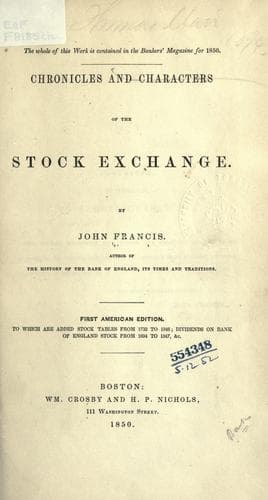
Chronicles and characters of the stock exchange — John Shaqi
Chronicles and characters of the stock exchangeFrancis, John, of the Bank of England
History
Chronicles and characters of the stock exchange
Francis, John, of the Bank of England
Speculation; Stock Exchange (London, England)
In the Royal Exchange, erected for less speculative and more
mercantile pursuits, were the early transactions of the moneyed
interest in the funds carried on. In 1695, its walls resounded with
the din of new projects; nor could a more striking scene be conceived
than that presented in the area of this building. The grave Fleming
might be seen making a bargain with the earnest Venetian. The
representatives of firms from every civilized nation—the Frenchman
with his vivacious tones, the Spaniard with his dignified bearing,
the Italian with his melodious tongue—might be seen in all the
variety of national costume; and the flowing garb of the Turk, the
fur-trimmed coat of the Fleming, the long robe of the Venetian, the
short cloak of the Englishman, were sufficiently striking to attract
the eye of the painter to a scene so varied. There, too, the sober
manner of the citizen formed a strong contrast to the courtier, who
came to refill his empty purse: and there also, as now, might be seen
the broken-down merchant, pale, haggard, and threadbare, haunting the
scene of his former glory, passing his now valueless time among those
who scarcely acknowledged his presence, and, as he had probably dined
with Duke Humphrey, supped with Sir Thomas Gresham.
“Trampling the Bourse’s marble twice a day,
Though little coin thy purseless pockets line,
Yet with great company thou art taken up,
For often with Duke Humphrey dost thou dine,
And often with Sir Thomas Gresham sup.”
A new impulse had been given to trade, and the nation was beginning
to feel the effect of the Revolution. William had already tried his
power in the creation of a national debt: jobbing in the English
funds and East India Stock succeeded; and the Royal Exchange
became—what the Stock Exchange has been since 1700—the rendezvous of
those who, having money, hoped to increase it, and of that yet more
numerous and pretending class, who, having none themselves, try to
gain it from those who have.
The charter granted by William to the Corporation of the Bank of
England is the first instance of a debt bequeathed to posterity.
Annuities had hitherto been the mode of raising supplies; and the
day, therefore, which witnessed the establishment of the Bank is
worthy of notice, as being also the day on which William laid the
foundation of an irredeemable national debt.
It was soon found that the duties appropriated to the various
payments of interest and annuities were insufficient to meet the
claims. In 1697, the national debt amounted to twenty millions, and
the revenue was deficient five millions. The payment in consequence
grew uncertain, and the moneyed men of the day, watching the course
of events, made large sums out of the distresses of government. “The
citizen,” says an old writer on the subject, “began to decline trade
and turn usurer.”
Public-domain text, read in full here on John Shaqi.
Reviews
Reviews
No reviews yet
Be the first to share your thoughts on this work.
Join the Discussion
Join the discussion
Sign in to leave a comment or review.
Sign InorCreate an account