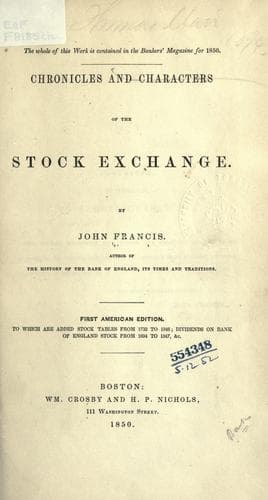
Chronicles and characters of the stock exchangeFrancis, John, of the Bank of England
History
Chronicles and characters of the stock exchange
Francis, John, of the Bank of England
Speculation; Stock Exchange (London, England)
dispensed with, and an additional time allowed to settle the accounts.
To mitigate the evil, the principal holders of foreign securities
formed themselves into a society to purchase all stock below forty;
but it was found inadequate to meet the catastrophe in the house,
while out of it the excitement in Spanish, Portuguese, and other
foreign funds created evils which never met the public eye, but which
are yet felt by innumerable private families.
During this period, the Royal Exchange, previous to the assembling of
the merchants, witnessed a curious scene, and beheld a motley group
of speculators; and, says Mr. Evans, in his work on the city, such
was the rage for shares in companies which had arisen out of the
general excitement, that the beadle was obliged to drive them away,
as the frequenters of ’Change could not get to their places. In the
height of this speculation, some of the dabblers made a price of one
farthing per share on a railway now promising to be the first in the
kingdom, but of which there were then no buyers.
With the above panic the present chronicle of the Stock Exchange
closes. To have brought it to 1849 would have involved living men
and their actions, and to some future historian must be left the
many whose names assume so important a position in English financial
history.
FOOTNOTES:
[7] “The prince of Hesse Cassel,” said Rothschild, “gave my father
his money. There was no time to be lost; he sent it to me. I had
£600,000 arrive unexpectedly by post; and I put it to such good use,
that the prince made me a present of all his wine and linen.”
[8] In 1824, it was said that public attention was so entirely
absorbed by financial operations, that the movements of Mr.
Rothschild and a few London capitalists excited an intensity of
expectation scarcely inferior to the march of armies.
[9] The intelligence of this gentleman was so good, that he was the
first to announce the Paris revolution of July to Lord Aberdeen, and
the victory of Waterloo was known to him some days before it was made
public.
[10] Mr. Salomons attributed the difficulties which followed his
death to the sudden withdrawal of the dexterity with which he managed
the exchanges, as Mr. Rothschild prided himself on distributing his
immense resources, so that no operation of his should abstract long
the bullion from the Bank.
[11] For a Memoir of Rothschild, see the Bankers’ Magazine, Vol. II.
p. 473, _et seq._
CHAPTER XVII.
_Legends of the Stock Exchange.—Mr. Dunbar.—Duke of
Newcastle.—French Ambassador.—James Bolland.—Extraordinary
Incident.—Fortunate Adventure.—Morals and Manners of the Stock
Exchange.—Its Constitution and Arrangements._
Public-domain text, read in full here on John Shaqi.
Reviews
Reviews
No reviews yet
Be the first to share your thoughts on this work.
Elsewhere in the archive
Join the Discussion
Join the discussion
Sign in to leave a comment or review.
Sign InorCreate an account