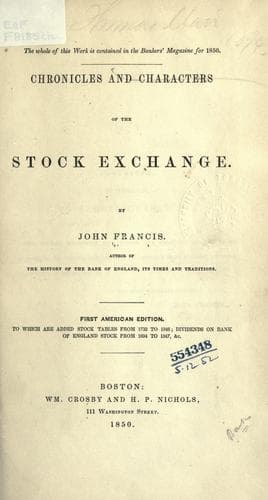
Chronicles and characters of the stock exchangeFrancis, John, of the Bank of England
History
Chronicles and characters of the stock exchange
Francis, John, of the Bank of England
Speculation; Stock Exchange (London, England)
The early part of the present chapter is devoted to anecdotes, which,
though difficult to prove, yet bear in themselves every appearance
of reality. Many legends are thus in the debatable ground between
truth and fiction; and those which are selected are chosen from their
resemblance to fact, rather than from the actual knowledge of their
veracity.
In 1761, Mr. Dunbar, a West-Indian merchant, finding his affairs
were less prosperous than usual, sought “the Alley,” as it was
then termed, to retrieve his failing fortunes. From some private
information, he believed that he had good grounds for supposing a
peace would soon be effected, and that the funds would rise. He
therefore ordered his broker to buy £100,000 for the account; told
him the opinion he had formed, with the intelligence on which it was
based; and the latter, in violation of his oath, jobbed extensively
on his own account as well as for his client. February passed away
without the expected peace, and Mr. Dunbar paid the difference.
Confident in his views, he continued the operation; but each
account-day proved that the price had been against him, and with
great difficulty did he find money to pay the amounts due. In July,
unable to pay cash, he gave notes of hand to the broker, who agreed
to receive them. No objection being made, the account was continued
on for August. In that month the prospect of peace revived, the funds
rose, and Mr. Dunbar, seeing a chance of paying the greater part
of his losses, went with all speed to ’Change Alley. His distress
may be imagined, when he was coolly told, that, since he had given
notes of hand, no account had been opened, and no advantage could be
reaped from the rise in price. The act of Sir John Barnard rendered
any appeal to law useless; but, as Mr. Dunbar became a bankrupt, the
members of the Stock Exchange subscribed to pay the amount claimed,
in order that so flagrant a case might not become public.
One of the loans raised by the Duke of Newcastle, when prime
minister, fell, from some unforeseen accident, to three per cent.
discount. His Grace, thinking he had made an unfair bargain, or
fearing the jobbers would not lend to him again, convened a meeting
of those who had taken it, who, as well as the Duke, were greatly
frightened, not knowing what project to adopt. At length one of
them—said to be Samson Gideon—desired the minister to walk with
him into another room. There they remained for a few minutes, and
then returned in high spirits, telling the others to go home and be
perfectly easy, as care should be taken of their interest. Gideon
went immediately to ’Change Alley, and, buying up the scrip as fast
as it was offered, produced an immediate rise to one per cent. above
par.
Public-domain text, read in full here on John Shaqi.
Reviews
Reviews
No reviews yet
Be the first to share your thoughts on this work.
Elsewhere in the archive
Join the Discussion
Join the discussion
Sign in to leave a comment or review.
Sign InorCreate an account