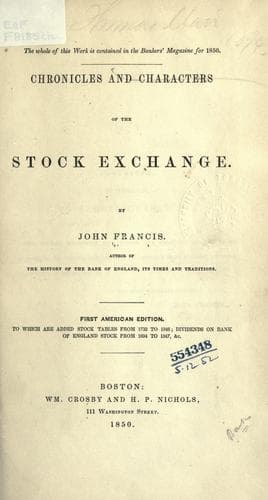
Chronicles and characters of the stock exchangeFrancis, John, of the Bank of England
History
Chronicles and characters of the stock exchange
Francis, John, of the Bank of England
Speculation; Stock Exchange (London, England)
Gambling in the funds has not been confined to commoners; and the
French ambassador at the Court of London was guilty of a deception
which marks the name of the Count de Guise with infamy. Availing
himself of his political position, he traded in English securities,
and, by the aid of his secretaries, made large sums. While success
attended the ambassador’s operations, he received the profit,
and rejoiced in his good fortune; but when a long run of bad
luck dissipated his gains, and made demands upon his purse, his
Excellency denied all knowledge of the transaction, refused to pay
the balance, retired to France, and commenced a prosecution against
his subordinates. But this was not sufficient to exonerate him
with thinking people. A memorial was published by his secretaries;
and the evidence they gave satisfied every impartial mind that the
ambassador of the Most Christian King had abused his trust, duped his
dependents, and defrauded the stock-broker.
About the middle of the eighteenth century, one of the constant
dealers in ’Change Alley, although in a small way, was James Bolland;
a man of low extraction, but of great mind, of immense impudence,
and unrivalled crime. There was nothing at which he would hesitate
to obtain money, to spend on the Stock Exchange; and, having
once commenced, he soon found that the legitimate profits of his
trade—that of a butcher—were not sufficient to support him. He
formed, therefore, a wooden weight, which, resembling one of fifty
pounds, weighed only seven pounds; and, in his capacity of tradesman
to St. Thomas’s Hospital, employed his roguery with great success.
From butcher he turned sheriff’s officer, revived every past
iniquity, invented new frauds, and spent his money in buying
lottery-tickets, to which pursuit he was passionately attached. He
robbed the broker whom he employed, alike of his mistress and his
money; and with the latter bought the place of city marshal. The
citizens, however, discovered that his character was scarcely equal
to his impudence, and refused to maintain their bargain.
Every moment he could spare was passed on the Stock Exchange,
where his pursuits were marked by a singularly bad fortune. Every
speculation went against him; he never drew a prize in the lottery;
and, finding there was a chance of his becoming penniless, he added
forgery to his long list of crimes. The fraud was discovered, the
penalty was paid at Tyburn; and James Bolland adds another to the
many proofs of the truth of the old adage.
Public-domain text, read in full here on John Shaqi.
Reviews
Reviews
No reviews yet
Be the first to share your thoughts on this work.
Elsewhere in the archive
Join the Discussion
Join the discussion
Sign in to leave a comment or review.
Sign InorCreate an account