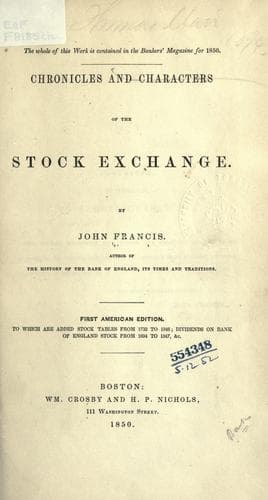
Chronicles and characters of the stock exchangeFrancis, John, of the Bank of England
History
Chronicles and characters of the stock exchange
Francis, John, of the Bank of England
Speculation; Stock Exchange (London, England)
A century ago was the hanging century; and a great fraud was
committed towards its close on the East India Company. The leading
witness—the only witness who could prove the guilt of the accused—was
accustomed to visit a house in the neighbourhood of the Bank, to be
dressed and powdered, according to the fashion of the day. Shortly
before the trial came on, a note was placed in his hands, informing
him that the attorney for the prosecution was desirous of seeing him,
at a certain hour, at his private residence, in or near Portland
Place.
At the time appointed, the witness proceeded to the house; the door
was opened, and the footman, without asking his name, ushered the
visitor into a large room, where, discussing some wine upon the
table, sat a group of gentlemen, in earnest conversation. “There is
a mistake,” exclaimed the new-comer, thinking he had been shown into
the wrong room. “No mistake, Sir,” interrupted one, in a determined
tone, while the remainder sat quietly, but sternly, by. Unable to
comprehend the scene, and, in some alarm, the visitor prepared to
leave the room. “There is no mistake,” repeated the same person,
unostentatiously stepping before the door. “I am,” he continued,
“brother to that gentleman who is to be tried for forgery, and
against whom you are the chief witness. Without your evidence he
cannot be convicted; the honor of a noble house is at stake; and
your first attempt to escape will lead to a violent death. There is
nothing to fear, if you remain quiet; but all whom you see are sworn
to detain you until the trial be over, or,” he added, after a pause,
“to slay you.” The witness was a sensible man; he saw the determined
looks of those around, and thought it best quietly to acquiesce.
In the mean time great surprise was excited in the city. That the
missing man had been inveigled away was universally believed; and
every endeavour was made to track him. Whether the calmness with
which he bore his confinement deceived his jailers is not known; but
it is certain that he effected his escape from the house, although
not so securely but that his captors were after him before he could
get out of sight. A mob collected; his pursuers declared he was an
insane nobleman, and that they were his keepers. The mob shouted with
delight at the idea of a mad lord; and the unfortunate man was on the
point of being again confined, when a chariot drove up. The inmate,
a lady, desired the coachman to stop, and listened to the counter
statements of the pursued and his pursuers. Remembering the current
story of a missing witness, she opened the carriage, he sprung in,
the door was closed, and the lady, to whom he told his story, ordered
her coachman to drive with all speed to the Old Bailey. It was the
last day; the case, which had been postponed, was being tried; and
the missing witness was just in time to place the rope around the
neck of the unhappy forger.
Public-domain text, read in full here on John Shaqi.
Reviews
Reviews
No reviews yet
Be the first to share your thoughts on this work.
Elsewhere in the archive
Join the Discussion
Join the discussion
Sign in to leave a comment or review.
Sign InorCreate an account