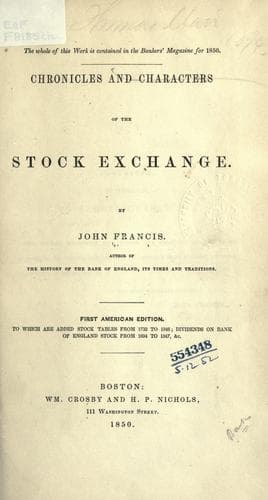
Chronicles and characters of the stock exchangeFrancis, John, of the Bank of England
History
Chronicles and characters of the stock exchange
Francis, John, of the Bank of England
Speculation; Stock Exchange (London, England)
I now, that I may not be said to speak without a precedent, I humbly
refer to those moneyed gentlemen to a case recent in memory, and
even in their own, which, though indeed they may think fit to have
forgotten for a time, they will all call to mind when they hear of it
again; and this was the case of two goldsmiths (knights also, and one
of them member of Parliament, too) in Fleet Street, who pushed at the
Bank of England at the time that the Pretender’s invasion from France
was in its preparation. One of them, it was said, had gathered a
quantity of Bank-bills, to the value of near £100,000, and the other
a great sum, though not so many, and, it was said, resolved to demand
them all at once.
Let the gentlemen I point at look back to the printed papers that
year; let them inquire what construction was put upon it; let them
inquire how the government resented it; how my Lord Treasurer
Godolphin looked upon it as a mine formed to blow up the queen’s
affairs, and how, in a word, all the friends of the government took
it to be such a step in favor of the Pretender, as was impossible to
consist with duty to the queen.
Let them inquire farther, with what difficulty Sir R—— Ho—— wiped
off the imputation of being a favorer of the rebellion, and how
often, in vain, he protested he did it with no such view, and how
hard the Whigs were to believe him. Sir F—— C——d, indeed, carried
it with a higher hand, and afterwards pretended to refuse the bills
of the Bank; but still declared he did it as a goldsmith, and as a
piece of justice to himself in some points in which the Bank had, as
he alleged, used him ill. But, in general, it was looked upon as an
open affront to the government, and an abetting and countenancing the
invasion of the Pretender from abroad, and the rebellion intended at
home. Nor was the government, much less were the authors of private
papers and prints, wanting in letting them know it; nay, if I am not
misinformed, they were threatened with being treated as enemies to
the government; and if things had gone on to extremities, they had
doubtless been marked out as persons the government were to take care
of.
Now I only speak in plainer words; it was said then, that such men
as endeavoured to run down the public credit were enemies to the
government. I know no distinction in the case, that should require
so much tenderness. Every subject of King George, who is at the same
time an enemy to King George, is a traitor; and every overt act of
that enmity, it being his duty to his utmost to favor, aid, and
support the government, is an overt act of treason, let it be gilded
over with what fine words the persons please, ’tis the same thing, if
it is not literal treason, and within reach of the statute, yet the
crime is in itself of the same nature.
Public-domain text, read in full here on John Shaqi.
Reviews
Reviews
No reviews yet
Be the first to share your thoughts on this work.
Elsewhere in the archive
Join the Discussion
Join the discussion
Sign in to leave a comment or review.
Sign InorCreate an account