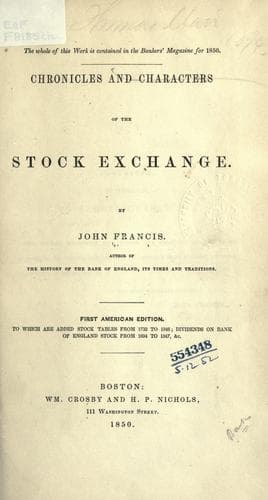
Chronicles and characters of the stock exchangeFrancis, John, of the Bank of England
History
Chronicles and characters of the stock exchange
Francis, John, of the Bank of England
Speculation; Stock Exchange (London, England)
Among those who employed their great fortunes in the manner alluded
to was Sir Henry Furnese, a Director of the Bank of England.
Throughout Holland, Flanders, France, and Germany, he maintained a
complete and perfect train of intelligence. The news of the many
battles fought at this period was received first by him, and the fall
of Namur added to his profits, owing to his early intelligence. On
another occasion he was presented by William with a diamond ring,
as a reward for some important information, and as a testimony of
this monarch’s esteem. But the temptation to deceive was too great,
even for this gentleman. He fabricated news; he insinuated false
intelligence; he was the originator of some of those plans which at
a later period were managed with so much effect by Rothschild. If
Sir Henry wished to buy, his brokers were ordered to look gloomy
and mysterious, hint at important news, and after a time sell. His
movements were closely watched; the contagion would spread; the
speculators grew alarmed; prices be lowered 4 or 5 per cent.,—for in
those days the loss of a battle might be the loss of a crown,—and Sir
Henry Furnese would reap the benefit by employing different brokers
to purchase as much as possible at the reduced price. Large profits
were thus made; but a demoralizing spirit was spread throughout the
Stock Exchange. Bankrupts and beggars sought the same pleasure in
which the millionnaire indulged, and often with similar success.
The wealthy Hebrew, Medina, accompanied Marlborough in all his
campaigns; administered to the avarice of the great captain by an
annuity of six thousand pounds per annum; repaid himself by expresses
containing intelligence of those great battles which fire the English
blood to hear them named; and Ramilies, Oudenarde, and Blenheim
administered as much to the purse of the Hebrew as they did to the
glory of England.
In the midst of these excitements arises a name which, to the
dwellers in London, is well known. Thomas Guy, the Bible contractor,
was a frequenter of ’Change Alley; and here, duly and daily, might be
seen that figure, which the gratitude of his fellow-men has rendered
familiar in the statue raised to his memory.
FOOTNOTES:
[1] The tontine is simply a loan raised on life-annuities. In
consideration of a certain amount paid by a certain number of
persons, government grants to each a life-annuity. As the annuitants
die, their shares are divided among the survivors, until the annuity
granted to the whole becomes centred in the longest liver; at his
death the transaction ceases.
CHAPTER III.
_Enormous Bribery by William.—Increased Taxation.—Speech of Sir
Charles Sedley.—Wrongs of the Soldiers.—Defence of William.—Moral
Disorganization of the Country.—First Exchequer-Bill Fraud.—First
Foreign Loan.—Romantic Fraud in 1715.—Political Fraud of ’Change
Alley.—Interference of the House of Peers.—First Hoax._
Public-domain text, read in full here on John Shaqi.
Reviews
Reviews
No reviews yet
Be the first to share your thoughts on this work.
Join the Discussion
Join the discussion
Sign in to leave a comment or review.
Sign InorCreate an account