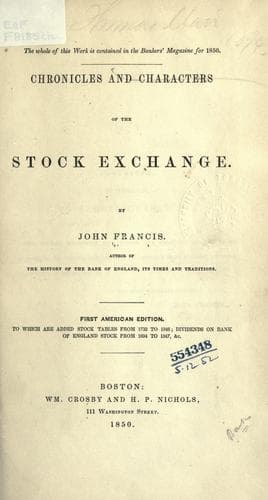
Chronicles and characters of the stock exchangeFrancis, John, of the Bank of England
History
Chronicles and characters of the stock exchange
Francis, John, of the Bank of England
Speculation; Stock Exchange (London, England)
If, however, any blame be attached to the government of William, how
much greater must be that which is attached to succeeding ministries.
They knew, for they felt, the evil of perpetual debts. Sir Robert
Walpole said, when the nation owed 100 millions it would be ruined;
but he, and those who preceded with those who followed him, persisted
in neglecting the only principle of action which could save the
country. It is the misfortune of governments to abide by that which
is only venerable from its antiquity, and persist in following
precedents when they should act upon principle. They forget—and the
fact cannot be urged too strongly—that government is a progressive
science, and that improvement is a law of nations as well as of
nature.
In 1696, while the gold was being recoined, exchequer-bills,
principally for £5 and £10, were introduced. Being issued on the
security of government, they supplied the place of coin, and were
found a great convenience, acting as state counters, which passed as
money, because the people knew that the government would receive them
at full value. The Lords of the Treasury were authorized to contract
with moneyed men to supply cash; and though these bills were at one
time at a discount, their credit rose daily, until they reached 1 per
cent. premium. They at first bore no interest; but when they were
reissued, £7 12_s._ per cent. per annum was paid, and they became a
favorite investment. The genius of Mr. Halifax invented them; and it
has required no genius on the part of succeeding ministers to issue
a supply whenever the wants of the government have demanded them.
When it is not convenient to pay these securities off, and they have
accumulated to an amount which attracts the notice of the Opposition,
or is calculated to depress the price, the consent of Parliament is
procured, and they are liquidated by being added to the fixed debt of
the country. They now form a regular supply to the ministry, and are
part of the floating or unfunded debt of England, bearing a premium
or discount in proportion to the credit of the nation.
Public-domain text, read in full here on John Shaqi.
Reviews
Reviews
No reviews yet
Be the first to share your thoughts on this work.
Join the Discussion
Join the discussion
Sign in to leave a comment or review.
Sign InorCreate an account