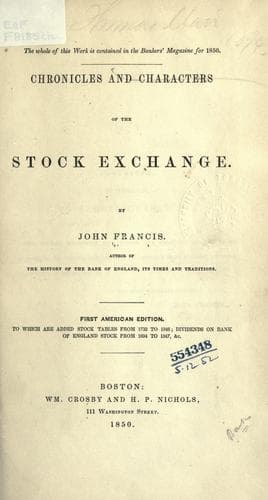
Chronicles and characters of the stock exchangeFrancis, John, of the Bank of England
History
Chronicles and characters of the stock exchange
Francis, John, of the Bank of England
Speculation; Stock Exchange (London, England)
But the clamor of the people reached her councils. It was said
our plans were betrayed to the enemy; treachery was justifiably
suspected; and all who were familiar with the period will join the
writer in thinking it not only possible, but probable.
During these trials the spirit of William remained unchanged; and,
rejecting all overtures from France, he exhibited to the world the
soldiership for which he was remarkable. At Namur he fought in the
trenches, ate his dinner with the soldiers, animated them with
his presence, shared their dangers, and won their hearts. Namur
capitulated, and the scene changed. The French power was shaken in
Catalonia; its coasts were assailed; its people were suffering, and
Louis, whose great general was dead, was sufficiently humbled to
renew his proposals for peace, which, after nine years’ war, costing
Europe 480 millions of money and 800,000 men, was gained by the
pacification of Ryswick.
A deep thinker of the present day has said of the war anterior to
1688,—and the argument is supported by that school of which Cobbett
was chief,—“The cost happily fell upon those who lived about the
time,—it was not transmitted to posterity, according to the clever
contrivance devised in a more enlightened and civilized age. They
spent their own money, and not that of their grandchildren. They did
as they liked with their own labor and its results; they did not
mortgage the labor of succeeding generations.”
Men do not argue thus, ordinarily. The case is very similar to that
of a land-proprietor mortgaging his estate to defend it from a
suit which endangers it. His posterity may regret, but they cannot
complain; they know it is better to have the estate partially
mortgaged than not to have an estate at all. It seems, to the writer,
similar with the national debts of the reign of William. He was
bound to defend the people who had chosen him; war was then, as
now, a popular pastime; and William is no more to be blamed that he
was not in advance of the time, than the nobles of the present day
are to blame because they bring up their younger sons to be shot at
for glory and a few shillings a day, instead of seeing, as their
successors will probably see, the anti-progressive and anti-Christian
nature of the principle thus supported.
The one great evil was, that the difficulty of getting money tempted
William to borrow on irredeemable annuities. Had he borrowed only on
annuities terminable in a century, he would have attained his money
at a little extra cost, but the pressure on the people would have
decreased year by year, the credit of the government have increased,
and the discontent of the nation been less.
Public-domain text, read in full here on John Shaqi.
Reviews
Reviews
No reviews yet
Be the first to share your thoughts on this work.
Join the Discussion
Join the discussion
Sign in to leave a comment or review.
Sign InorCreate an account