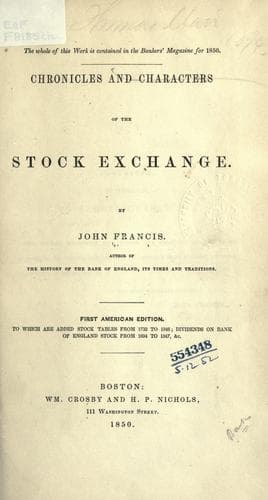
Chronicles and characters of the stock exchangeFrancis, John, of the Bank of England
History
Chronicles and characters of the stock exchange
Francis, John, of the Bank of England
Speculation; Stock Exchange (London, England)
In the early part of the eighteenth century, a prospectus was issued
to the commercial world and the members of ’Change Alley, in which
the wants of the needy and the infamy of the pawnbrokers, the purest
philanthropy and a positive five per cent., were skilfully blended.
It was shown that then, as now, the poor were compelled to pay a
greater interest than the rich; that thirty per cent. was constantly
given by the former on a security which the usurer took care should
be ample; and it was proposed that the wealthy capitalist should
advance, for the benefit of the needy, a sufficient sum to enable
the company to lend money at five or six per cent. The proposal
proved eminently successful. A capital of £30,000 was immediately
subscribed, a charter obtained, and the “Charitable Corporation,”
the object of whose care was the necessitous and industrious poor,
appeared to flourish. For some years the concern answered, the
poor received the assistance which they required, and the company
was conducted with integrity. In 1719, however, their number was
enlarged; their capital increased to £600,000; an augmentation of
business was looked for; cash credits were granted to gentlemen
of supposed substance; and the importance of the corporation was
unhappily recognized by that numerous class of persons compelled
to pay in maturity for the excesses of youth. They acted also as
bankers, and received deposits from persons of all classes and
conditions. Its direction boasted men of rank, its proprietary men of
substance, and its executive men of more capacity than character. The
cashier of the company was a member of the senate; Sir Robert Sutton,
a director, was one of his Majesty’s Privy Council; and Sir Archibald
Grant, who took a prominent part in the affairs of the corporation,
was also a member of the lower house. Every confidence was reposed in
such a body, and it was regarded as a rich and prosperous society.
Public-domain text, read in full here on John Shaqi.
Reviews
Reviews
No reviews yet
Be the first to share your thoughts on this work.
Join the Discussion
Join the discussion
Sign in to leave a comment or review.
Sign InorCreate an account