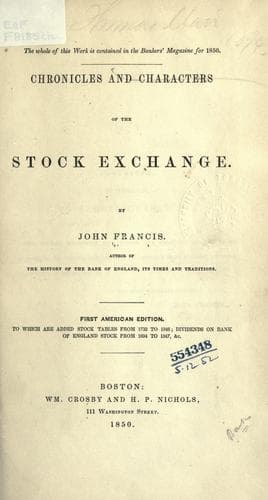
Chronicles and characters of the stock exchange — John Shaqi
Chronicles and characters of the stock exchangeFrancis, John, of the Bank of England
History
Chronicles and characters of the stock exchange
Francis, John, of the Bank of England
Speculation; Stock Exchange (London, England)
Under these circumstances, the surprise of the public may be
conceived when it was first whispered, and then openly announced,
that the cashier, with one of the chief officers, had disappeared
in company. The alarm spread to the proprietors; the public
participated; the poor assembled in crowds; the rich clamored for
information; a meeting was called to inquire into the case, when
a most pernicious, but scarcely comprehensible, piece of villany
was unravelled, and a most disgraceful tissue of fraud discovered.
£30,000 alone remained out of half a million. The books were
falsified; money was lent to the directors on fictitious pledges;
men of rank and reputation were implicated; suspicion and censure
followed persons of importance. Some managers were found to have
connived at scenes so disgraceful, that their character was lost for
ever. Many had concerted active plans of fraud, which ended alike in
their own ruin and the ruin of the corporation; while others were
guilty of personally embezzling the funds of the company. Petition
after petition was presented to the Commons. A bill was brought in
to prevent the defaulters from leaving the kingdom; and the scorn of
all England pointed at the men who, under the guise of charity, had
enriched themselves. The interest which was taken in the discovery
by the entire country attracted the attention of the Jacobites; and,
as one of the party had fled to Rome with the spoils, the Pretender
endeavoured to enlist the sympathy of the nation, through one Signor
Belloni, who wrote to the committee, stating that the refugee had
been seized and placed in the castle of St. Angelo. The Whig party,
ever jealous of the Pretender, voted that the letter should be burned
by the hangman at the Royal Exchange.
The distress occasioned by this bankruptcy was appalling, pervading
nearly every class of society. Large sums had been borrowed at high
interest. The small capitalist was entirely ruined; and there was
scarcely a class in English life which had not its representative
and its sufferer. The poor were unable to get their goods; the rich
were robbed of their jewels; families accustomed to affluence were
starving; delicate women, hitherto irreproachable, were compelled to
exchange their persons for bread. Similar evils have been known to
exist during sieges; and, in the public streets of Lisbon, women of
unblemished virtue offered themselves for sale during its occupation
by the French; but the writer believes there is no other parallel in
commercial history.
Public-domain text, read in full here on John Shaqi.
Reviews
Reviews
No reviews yet
Be the first to share your thoughts on this work.
Join the Discussion
Join the discussion
Sign in to leave a comment or review.
Sign InorCreate an account