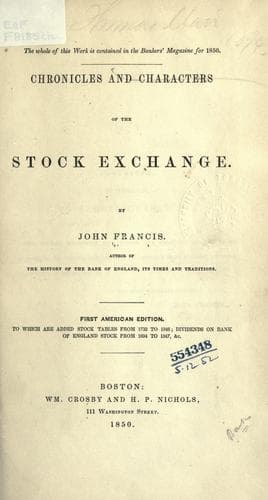
Chronicles and characters of the stock exchangeFrancis, John, of the Bank of England
History
Chronicles and characters of the stock exchange
Francis, John, of the Bank of England
Speculation; Stock Exchange (London, England)
England, Holland, and the Empire were opposed to France, Spain,
and Bavaria; and the war thus commenced was a memorable contest.
Marlborough and Peterborough, than whom England boasts none greater,
made her name a word of dread for many years. The knight-errantry
of Peterborough conceived schemes which only his ardent and
fiery imagination could achieve. He took towns by storm, under
circumstances little less than marvellous; he reduced the largest
and strongest cities of Europe with a handful of soldiers; he made
forced marches, shared the fatigues of his men, and took entire
reinforcements prisoners. With 3,000 troops he harassed a regular
army, cut off communications, and raised sieges; he forced towns with
horse-soldiers, and chivalrously mortgaged his estates to pay the
expenses incurred in the cause of his country.
The victories of John Churchill, Duke of Marlborough, were more
important to the nation than those of the adventurous Peterborough;
and if his glory was tarnished by the love of gold, yet the name
of Marlborough as a captain is unsullied. The battle of Blenheim
was his first great achievement in the War of Succession, and it
made the people consent to pay the additional taxes imposed upon
them. Innumerable trophies,—hundreds of flags and standards, tents,
cannon and mortars, casks and barrels filled with the precious
metals,—evinced the glory of the contest, and added to the pride of
the nation. The thanks of the House were voted to the Duke; medals
were struck in his honor; Addison celebrated him in poetry; but
dearer far to Marlborough than medal, poetry, or thanks, was the
rich manor and the noble mansion of Woodstock, voted to him by the
nation. Scarcely had the people recovered from the joy occasioned
by the battle of Blenheim, and from the increased taxation which
ensued, than another battle—that of Ramilies—seized them with
delight. Forgetful of the consequences, men talked of the old days
of England,—of the ancient victories of her armies,—of the time
when the great Cromwell made the English name terrible,—and, in
their excitement, they magnified the grandeur, and diminished the
cost. The pride of Louis was indeed humbled. He made proposals for a
congress; he tampered with the Dutch; he besought the interposition
of the Head of the Church; he offered to cede Spain, Milan, Naples,
or Sicily; and felt bitterly the consequences of having provoked
the vengeance of the island he hated. Ambition had, however, seized
upon the nation; conquest only was thought of; and, remembering the
glory of the past, the English people deemed themselves entitled
to some privilege for the blood which was shed. They forgot that
a new campaign would bring new costs; and they forgot, what their
successors yet feel, that every fresh victory brought a fresh loan.
Oudenarde, the third of that splendid series of victories which has
made the name of Marlborough renowned in the land, was followed by
Public-domain text, read in full here on John Shaqi.
Reviews
Reviews
No reviews yet
Be the first to share your thoughts on this work.
Join the Discussion
Join the discussion
Sign in to leave a comment or review.
Sign InorCreate an account